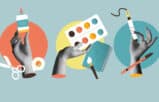


Creative hobbies — whether painting, ceramics, pie baking or guitar playing — bring significant benefits, even if you’re “no good at creative stuff.” In fact, the worse you are, the better off you may be.

Table of contents
You Don’t Have to Be Good at It
Of all the objections I hear when I talk about creativity, the most common (and most stubborn) is this: “I’m just not creative.”
We often define creativity narrowly; it means making art, writing fiction, or being the kind of person who plays guitar at dinner parties. You either have it or you don’t, and if you think you don’t, the whole idea of creative rest seems kind of irrelevant, right?
But this framing misses the point, and it keeps a lot of lawyers from accessing one of the most effective recovery strategies available to them.
You don’t need to be good at a creative activity to get the neurological benefits of doing it.
In 2016, researchers at Drexel University studied the effect of art-making on cortisol levels (a physiological marker of stress) in 39 healthy adults. Participants made art for 45 minutes using materials like collage, clay, markers and paint. Cortisol was measured before and after. It was only a small study, but the results were striking: 75% of participants showed a measurable reduction in cortisol after making art. Critically, there was no correlation between prior art experience and the cortisol drop. The beginners benefited just as much as the people who had been making art for years, and participants reported that making art (even if they weren’t good at it) was enjoyable and freeing.
The recovery happens in the doing, not in the quality of what you produce.
This makes sense when you consider what creative activity does to your brain. As I wrote in my last article, creative rest activates the brain’s default mode network: the state associated with insight, incubation, and the kind of background processing that lets solutions surface when you’re not forcing them. That shift happens any time you’re absorbed in an activity, not just when you’re doing it well. A beginner working with watercolors is just as cognitively absorbed as someone who has been painting for 20 years.
Arguably more so, because everything is new.
‘Flow’ Helps Silence Your Inner (Art) Critic and Trigger Real Recovery
This is also the essence of what psychologist Mihály Csíkszentmihályi called “flow” — the state of total absorption that reduces anxiety and restores mental resources. Flow doesn’t require mastery. It requires engagement at the right level for where you are. A lawyer who picks up a guitar for the first time can experience flow. A novice gardener can experience flow. The activity just needs to be engaging enough to hold your attention and low-stakes enough that the outcome doesn’t feel like a performance review.
That last part matters. I want to say something directly to the lawyers who are thinking: “But I’d be terrible at it, and that would be embarrassing.”
Terrible is fine. Terrible is, in fact, ideal.
When you’re new at something, you have no expectations to manage and no standard to maintain. Your inner critic (that voice honed to a fine edge by years of legal training) doesn’t quite know what to do with you. It has no precedent to judge you against. In that gap, something useful happens: The activity becomes genuinely restful, because there is no performance to deliver. You’re just making something that isn’t a legal brief.
A friend and colleague of mine discovered this when she fractured her dominant wrist and, unable to do her usual creative work, started making art with her non-dominant hand. The inner critic went quiet.
“It had no expectations of my left hand,” she told me. “So everything I made counted as art. For the first time, I felt completely free.”
That freedom eventually followed her into her professional life as well.
The bar for what counts as “creative” is also much lower than most people assume. Arranging flowers. Making a playlist. Trying a new recipe. Rearranging a room. Building something from a kit. Knitting, doodling, journaling, or even painting-by-numbers. None of these requires special talent. All of them qualify as creative hobbies for lawyers.
Research on everyday creativity shows that ordinary creative acts, regardless of their scale or sophistication, deliver the same psychological benefits as higher-profile artistic pursuits.
Your Assignment
So if you’ve been opting out of this conversation because you’ve convinced yourself you’re just not creative, I invite you to reconsider. Pick something you’ve been vaguely curious about, something where being terrible carries absolutely no professional risk, and try it for 20 minutes this week.
You don’t need to be good at it. You don’t need to finish it, share it or be proud of it. You just need to do it.
Your cortisol levels won’t care either way.
Catch up on Karen Skinner’s Lawyer Creativity Series
Read “The Law Firm Productivity Myth That’s Burning Lawyers Out” and “Why Your Brain Needs Creative Rest (and What That Actually Looks Like)”
More Healthy Lawyer Productivity Tips
- Micro-Recovery: 5 Small, Realistic Ways to Reduce Stress During a Busy Workday
- How Doodling Makes You a Better Listener (and 3 More Benefits)
- Delegation Isn’t Just a Work Hack, It’s a Life Hack: 5 Personal Tasks to Delegate Now
- Got a Process for Your Processes? Create Law Firm SOPs in 5 Easy Steps
- Why Lawyers Need Boredom
- Indoor Fitness Tips for Attorneys With Busy Schedules
- Why Are You at the Office Until 10 p.m.?
- Top-Rated Mindfulness and Meditation Apps
- How to Be Productive When You’re Depressed
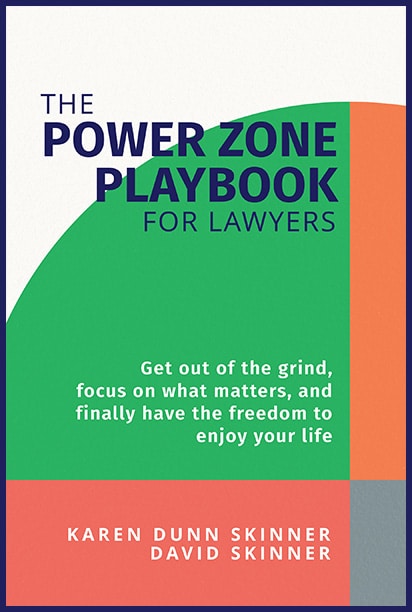
Get the Power Zone Playbook for Lawyers
By Karen Dunn Skinner and David Skinner
Get out of the grind and into your power zone! Learn to align the work you do with the work you love, finding the sweet spot where your expertise, passion, and client needs intersect. It’s here, in your Power Zone, that you will discover the secret to a thriving practice.
Everything you need is in your Playbook.
Images © iStockPhoto.com