


There are at least four big benefits to doodling in meetings, or during CLEs and long conference calls — really any time your mind wants to wander.

In the following, I hope to convince deeply professional, well-educated, multi-degreed grown-ups to doodle. And sure, doodling may be the very last activity you’d look at to boost productivity, uncork your creative genius or deepen your listening skills. Just one long sentence into this post, and you are already rolling your eyes so hard your hat fell off. But stay with me. There’s science. There’s history. There are famous people.
1. Doodling Develops the Mind
Doodling occupies one part of the mind while another part of the mind does important work. Here’s the part where I link to a paper by a cognitive scientist and an article from the Atlantic and PBS. But you don’t really need scholarship here, because you know this. Once in your life, you were 7 years old, armed with a crayon, facing a wall in the living room that you subsequently improved with a drawing of a dog and some stars and what historians insist is the sun, but which may also be a yellow balloon with hair.
Doodling engages the mind in active cognition, just like writing notes by hand. (Scroll the end of this post for more on that.)
This is not the same as simply occupying someone’s time while they fidget with a fidget spinner (which has exactly zilch science backing up every $15 sale). People who doodle during lectures are typically better at recalling cogent parts of the lecture. They’re not distracted, they’re engaged.
2. It Lets Your Brain Run Creative Problem-Solving in the Background
So, should you doodle on the job when your job involves law and justice and generally being freakishly smart?
It might not be a bad idea. The science related to doodling shows that engaging the brain in the generative act of scribbling allows the creative mind to run loose in the background. This is why highly creative people sometimes seem like they’re in la-la land, drawing anime on a legal pad, and then suddenly bark out the perfect solution to a problem.
Just because they don’t look like they’re thinking doesn’t mean they aren’t.
Consider Stanislaw Ulam. A brilliant mathematician, Holocaust escapee and one of the bigger brains on the Manhattan Project, Ulam once parked his dazzling dome at a lecture in 1963. Like anyone at a lecture, Ulam found himself bored enough to doodle. Being a math guy, he drew positive numbers in a square spiral. As the lecturer droned on, Ulam marked all the prime numbers appearing in the square and discovered Ulam’s Spiral. This mathematical exercise not only shows the gorgeous spatial relationship of prime numbers, but it may also have provided a solution for the Goldbach Conjecture, which has been driving mathematicians nuts since 1742.
3. Doodling in Meetings Is Active Listening
But isn’t doodling just daydreaming on paper? Not according to that 2010 paper published by Jackie Andrade of Plymouth University. When evaluating the benefits of doodling in meetings, Andrade determined that doodling does not distract from the primary task; rather, it acts as a focusing agent.
Imagine you’re in a meeting about prior art in a patent case. During the brief introduction, your mind wanders into a daydream about surfing. Then you start wondering if you have enough moola in your vacation fund to get to Maui in January and, no, you don’t, but if you sell some stock from the mutual fund and use some miles for the flight … Oh crap! The actual meeting has started and you have no idea what’s under discussion.
That’s because daydreaming is not an idle exercise — it uses enough executive functions that you cannot pay attention to the speaker. Unless you doodle.
Unlike daydreaming, doodling doesn’t use a lot of cognitive resources. It uses just enough brain power to keep you from daydreaming — but not so much that you don’t pay attention.
It’s a focusing agent.
Andrade’s study had 40 college kids listen to a phone call. Some doodled, some didn’t. Doodlers were able to recall 29 percent more of the call than non-doodlers.
For the purely competitive, if you doodle during a call or in a meeting, you might end up nearly 30% more informed than your peers.
4. Doodling Helps Lower Stress
Perhaps the most valuable and intangible benefit of doodling in meetings (and any other time) is the simplest. It reduces stress. I could cite Psychology Today to prove it, but come on: How stressed can you be when you’re filling up a page with little drawings of cats?
How Do You Doodle?
You wouldn’t think doodling needed an instruction manual, but what if you’ve been disassociated from your 7-year-old self for so long you’re rusty with the squiggles?
Fortunately, there are books like “The Doodle Revolution,” “Doodling for Academics,” and “Doodling in French.” There are also books predating the doodle revolution — by a long shot. “What to Draw and How to Draw It” was published in 1920. It will teach you how to draw squirrels, pastoral scenes, fat rich guys and more by giving you doodle hacks.
Check out the image below. From just two squares and some easy outlining, one can draw a decent picture of a cat.
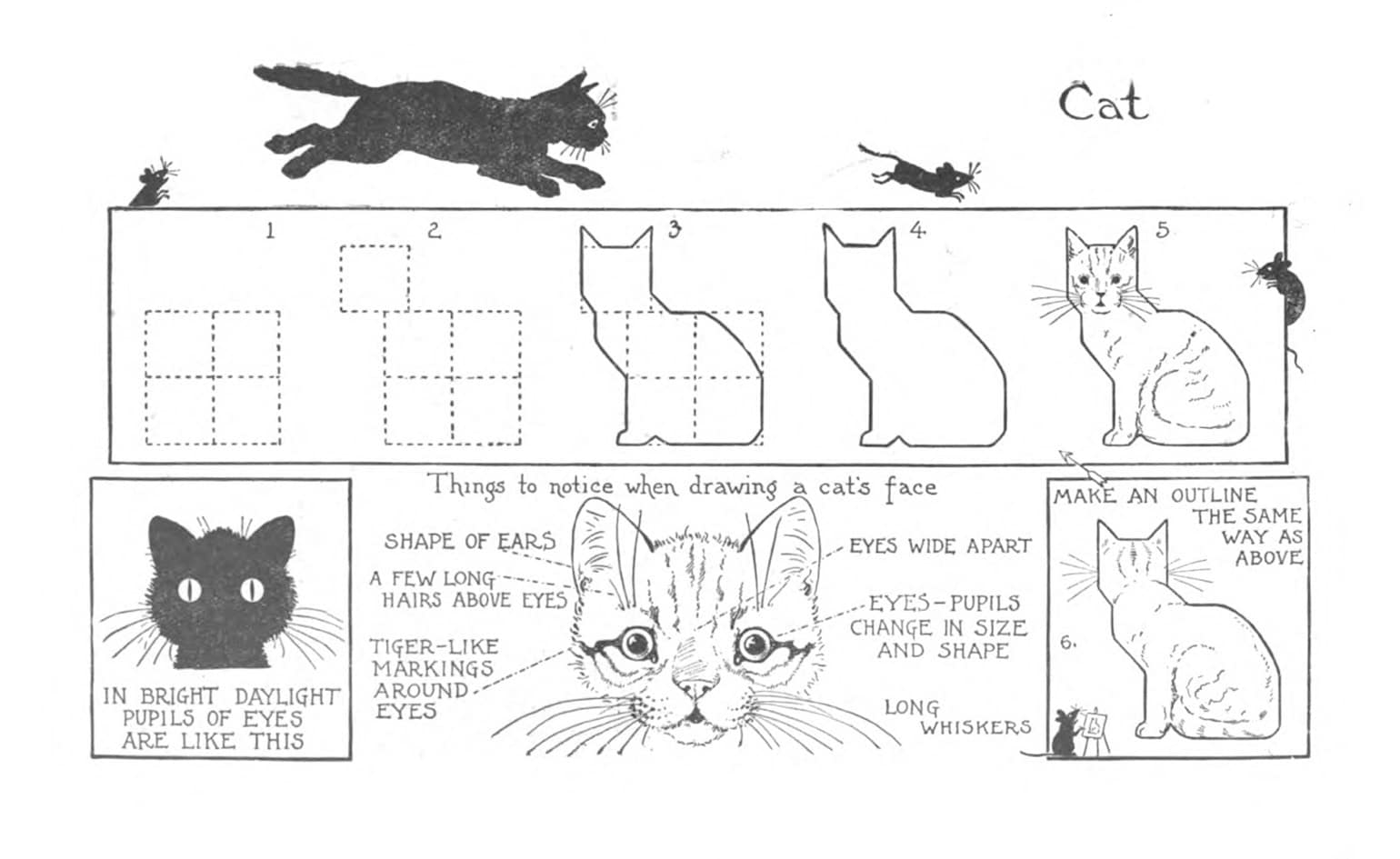
Drawing hacks are important stepping stones for many people who are not talented illustrators. But there’s another benefit: Learning these tricks allows you to draw the same image over and over perfectly. Doing so is a kind of meditation, like drawing a mandala. The drawing focuses your attention. The ritual of drawing the same image from practiced strokes allows you to do this while actively listening.
Of course, the resurgence of doodling has reached retail. Not only can you become a certified doodle instructor through Zentangle, you can doodle in style with drawing tools like the Mastermind desk pad from Baronfig. It’s a luxuriously designed scratch pad with a 12-by-8-inch footprint printed with a dot grid. It takes ink without bleed-through. Or, there’s a similarly featured Notsu Dot Grid Notepads on Amazon in sizes ranging from 11×17 to 3×6.
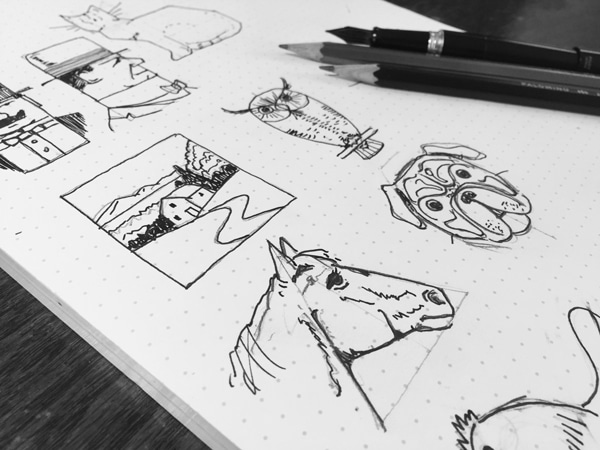
Below, I used a Palamino 602 and a Pilot Metropolitan to follow the easy instructions in the 1920s manual. In just a few minutes, I’d knocked out a passable horse, a terrible dog and an indifferent owl.
You Were Promised Famous Doodlers
Famous and celebrated doodlers include John Keats, Sylvia Plath, David Foster Wallace and most American presidents. A surely incomplete list of doodlers-in-chief: Thomas Jefferson, Andrew Jackson, Rutherford B. Hayes, Theodore Roosevelt, Warren G. Harding, Herbert Hoover, Franklin Delano Roosevelt, Dwight D. Eisenhower, John F. Kennedy, Lyndon B. Johnson and Ronald Reagan.
Some people claim Picasso doodled, but Picasso was Picasso, and anything he drew was art. Same with Walt Disney — if he drew Mickey Mouse in the margin of a book, it wasn’t a doodle. It was a cartoon.
Writing By Hand Is Another Way to Focus Your Mind
Ed. Note: Much has been written about the benefits of writing by hand, including by your favorite doodling author, Bull Garlington. If you’ve thought about improving your handwriting skills, you will want to read his article, “How Writing by Hand, and Slowing Down a Little, Improves Your Work.”)
Illustration ©iStockPhoto.com
Subscribe to Attorney at Work
Help us grow and get really good ideas every day: Subscribe to the Daily Dispatch and Weekly Wrap (it’s free).