

Maybe the most resilient response isn’t always “I can handle it,” but instead, “Yes, I can, but I choose not to handle it this way.” Perhaps it’s time to challenge the myth of resilience.

“Lawyers need to be more resilient.” When lawyers are struggling with stress and burnout, difficult clients, impossible deadlines, or the general intensity of practicing law, resilience is often presented as the answer. Learn to bounce back. Develop coping skills. Perhaps there is a healthier, more empathetic way.
‘Suck It Up’ Isn’t a Good Sustainability Recipe in the Practice of Law
Certainly, there is value in being able to recover from difficult experiences. We can all benefit from being resilient. But have we taken the concept of resilience a little too far? I mean, telling people to become “more resilient” ignores the conditions that are making them miserable.
What if the goal isn’t to become better at enduring stress? Or pretending it doesn’t exist? What if the goal is to create a professional life that doesn’t require us to endure quite so much stress?
What if the goal is sustainability instead of resilience? Here are five ways to think differently about resilience.
1. Stop Measuring Your Success by How Much You Can Handle
Most of us are good at handling it all. “Can I handle this?” “Why, yes, I can.” We handle the difficult client. We handle the late-night email. We handle the additional matter. We handle the emergency that somehow became our emergency. We handle the week that was supposed to be manageable but wasn’t.
The problem is that our ability to handle something isn’t the same as whether our life is healthy or sustainable. We tend to measure our professional success by what we accomplish, not by what it costs us to accomplish it. If the work gets done, the deadline is met, and the client is satisfied, then the day was a success. We are a success, whether we have anything left in the tank or not.
But our capacity is not limitless.
We have cognitive capacity, emotional capacity, physical capacity, and even capacity for uncertainty. And those reserves can be depleted. Sleep, stress, workload, relationships, health, and what else is happening in our lives all affect how much capacity we have available on a given day to handle our professional responsibilities. The more we handle, the more we may not be able to handle. And that’s normal.
So instead of always asking, “Can I handle this?” try asking, “What is handling this going to cost me?” If the answer points to an unsustainable or unhealthy outcome, focus on setting boundaries, delegating, and other ways the task can be accomplished with less strain on your capacity.
2. Build Recovery into Your Work, Not Just After It’s Complete
We often think about recovery as something that happens after the stressful thing is over. We’ll get some rest after the trial. We’ll take a vacation after the transaction closes. We’ll catch up on sleep after the big deadline.
The problem is that lawyers often don’t get much of an “after.” One demanding matter runs into another. One deadline is followed by another. And sometimes the next crisis arrives before we’ve finished processing the last one (or even finished handling the last one). Thankfully, recovery doesn’t require a week at the beach or even a long weekend of sleeping. It can happen in much smaller increments.
Even short breaks serve an important purpose.
A quiet transition after a difficult meeting. Ten minutes without email between challenging tasks. A lunch that isn’t spent answering messages. A period of time without your phone. These things may sound insignificant compared to a vacation, but they interrupt the pattern of continuous activation and help lower stress. Plus, they are much more accessible and possible.
We don’t need to eliminate periods of intense work. Law will always have busy seasons and demanding matters. But if every period of intense effort is immediately followed by another one, we eventually stop recovering at all. Lack of recovery is not the same as lack of resilience. Allowing ourselves to recover improves resilience.
To make sure you have time to recover, build in a 15-minute habit that works for you throughout your day: a stretch break, a walk around the block, singing in the car on your commute home, or sleeping late one morning a week. Anything that makes you feel refreshed.
3. The Myth of Resilience: Stop Viewing Your Working Environment as Unrelated
There is an unhelpful assumption built into some wellness advice that lawyers often receive: If you are sufficiently resilient, you should be able to function well regardless of your environment. That’s not true.
Imagine two lawyers with the same skills and personalities. One works in an environment with reasonable expectations, supportive colleagues, some control over their schedule, and a supervisor who understands that everything cannot be urgent. The other works in an environment where everything is urgent, staffing is inadequate, boundaries are nonexistent, and being constantly available is considered part of being a good lawyer. We shouldn’t be surprised if those two lawyers have very different experiences of stress.
Of course, we can’t always choose or change our work environment, and even when we do, we still can’t completely control it. But that doesn’t mean the environment is irrelevant to our stress levels.
Workload, autonomy, staffing, management, psychological safety, response expectations, and the ability to disconnect all affect our capacity to stay well. They are conditions that influence whether people can do demanding work sustainably – in other words, for the long haul. While a resilient person may be able to function in a difficult environment, that doesn’t mean a difficult environment is irrelevant to your resilience.
If you can change your work environment in any positive way, try it.
That doesn’t necessarily mean leaving your work, getting a new job, quitting the practice of law, or making other really big decisions. It could mean any of those, but it could also mean committing to not work with a particular colleague, setting boundaries on your time, or delegating more. Little changes can make a big difference in our working environment and our ability to sustain our work.
4. Pay Attention to Recovery Time, Not Just Performance
We are used to measuring performance. Did we meet the deadline? Did we win the case? Did we catch the issue? Did we satisfy the client? Did we produce good work? Did we settle the matter? All good questions, but we often forget another important question: How long did it take to recover?
Think about the last particularly difficult week you had. How long did it take before you felt like yourself again? Was it Friday night? Sunday afternoon? Monday morning? Or did you spend the entire weekend exhausted, irritable, distracted, or simply trying to recover enough energy to start again? Do you always dread Monday?
Recovery time is information.
If we routinely need the entire weekend to recover from the work week, if a difficult meeting leaves us physically tense for the rest of the day, if we finish a major project and immediately feel relief rather than satisfaction, all of that tells us something. We might think it tells us that we aren’t resilient. Not true. Maybe it simply means we need recovery time built into our work.
You may be incredibly resilient, but without time for recovery, you won’t feel like it. Start measuring the time it takes to really recover from different stressors, and then develop a plan to work into your regular workday snippets of recovery time or take longer recovery breaks when needed, when you can.
5. Redefine Resilience as Knowing When Not to Push Through
Perhaps the biggest problem with the way we talk about resilience is that we have made “keep going” its unofficial definition. But sometimes the resilient thing is not to push through. Rather than “sucking it up,” the better, more resilient – and sustainable – choice might be:
- Asking for help
- Renegotiating a deadline
- Delegating a task
- Taking a real break instead of squeezing in another task
- Changing how we approach our workload
And sometimes, if the circumstances allow it, it may mean deciding that a particular job, role, or environment isn’t sustainable.
There is an important difference between giving up because something is difficult and making an intelligent adjustment because the current approach isn’t working. We don’t consider a lawyer less competent because they recognize that a legal strategy isn’t working and change course. We shouldn’t apply a different standard to our own careers and lives.
Maybe the most resilient response isn’t always, “I can handle it.” Sometimes it is, “I can handle this, but I choose not to handle it this way.”
Reality vs. The Myth of Resilience: Why True Grit Still Has Its Place
We need the ability to navigate difficult situations, recover from setbacks, and keep moving when things don’t go according to plan. But resilience shouldn’t mean becoming so good at absorbing stress that we stop noticing what the stress is costing us. A better goal is sustainability.
Listen to Jamie Spannhake’s latest column:
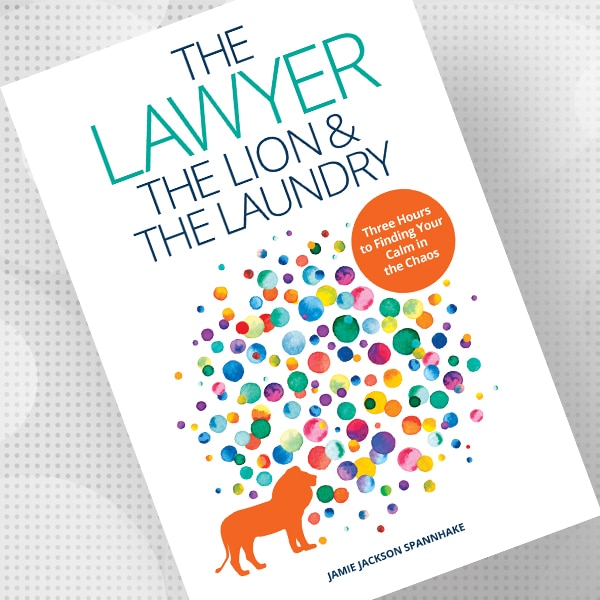
Three Hours to Finding Your Calm in the Chaos
BESTSELLER! THE LAWYER, THE LION & THE LAUNDRY
Join lawyer and certified health coach Jamie Jackson Spannhake in an enlightening journey. Read her bestselling book and learn how to “choose, act and think” in ways that will clarify your desires and set priorities so you can reclaim your time and enjoy your life. Includes exercises.