


A person’s ability to do a job well is not the same thing as their ability to do it under every (im)possible working condition. Here’s why legal employees should change certain work requirements and adopt policies to support women experiencing menstruation and menopause.

As discussed in The Motherhood Penalty, the Daddy Track, and What the Legal Profession Gets Wrong About Parents, the legal profession has made progress in recognizing the parenthood penalty. Or, at the very least, law firms have received guidance from reputable sources on how to reduce the inequities lawyers face when they become parents.
There is another workplace issue causing discrimination among workers, and it’s often unrecognized by employers, including law firms: menstruation and menopause.
The ISO Recommends New Workplace Policies
The International Organization for Standardization recently published its occupational health and safety manual on menstruation and menopause in the workplace. In the 60-page report, ISO provides guidance for developing workplace policies and practices that support workers’ menstrual and menopausal health by helping organizations identify practical adjustments, supportive mechanisms, and inclusive approaches that can reduce stigma and address barriers at work — all with the goal of retaining experienced workers in a way that increases an organization’s bottom line.
Most importantly, the ISO report makes clear that the recommended policies are about recognizing that a person’s ability to do a job well is not the same thing as their ability to do it under every (im)possible working condition.
5 Reasons to Stop Ignoring Menstruation and Menopause at Work
Here are five reasons legal employers should consider adopting policies to support workers experiencing menstruation and menopause.
1. The way someone works is not the same as their ability to do the job.
If an employee has low back pain and requests an adjustable sit-to-stand desk, does that make the employee less competent? Of course not. If a pregnant employee needs more bathroom breaks than others, do we assume that person has diminished legal expertise or professional judgment? No, that would be ridiculous.
Yet when someone needs flexibility because of menstruation or menopause symptoms, the response can be quite different. The request may be treated as an inconvenience, a lack of commitment, or evidence that the person cannot handle the demands of the profession. But why, when menstruation and menopause are normal biological processes that currently affect 3.1 billion people around the world?
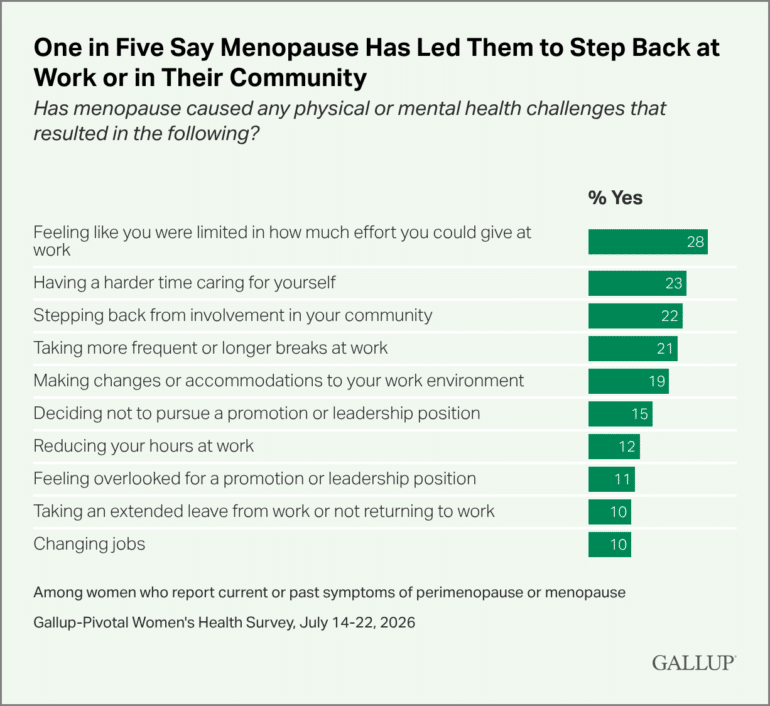
A recent Gallup-Pivotal Women’s Health Survey revealed the huge disparities in women’s healthcare, including how women’s health needs impact their careers. Among women in the workforce, 42% say their health has limited their career in some way in the past five years. This includes feeling that a promotion, leadership role or new job is unrealistic and that they can’t live up to their full potential at work. In the same survey, 4 in 10 women who have experienced menopause or perimenopause say it has negatively affected their life or work in one or more of nine different ways (below), including feeling limited in how much effort they could give at work, deciding not to pursue a promotion, reducing hours, taking an extended leave, or exiting the workforce.
Menstruation and menopause can involve pain, heavy bleeding, fatigue, hot flashes, sleep disruption, and difficulty concentrating, among other symptoms. These experiences vary considerably from person to person.
The point is not that everyone needs an accommodation. The point is that some workers may need a change in how they work, not a change in what they are capable of accomplishing.
For attorneys, that might mean adjusting a meeting schedule, allowing remote work when practical, providing access to a private space, or permitting additional breaks. The appropriate solution will depend on the person, the work, and the circumstances.
2. Retaining experienced workers is good for a business’s bottom line.
This is the part that may speak most to legal employers. Supporting workers is not just the right thing to do. It also makes financial sense.
Think about an attorney in their late 40s or 50s who has spent years developing expertise in a particular practice area. They know the clients, understand the history behind a difficult matter, recognize the pitfalls that a less experienced attorney might miss, and can mentor younger colleagues. They are likely a trusted source of institutional knowledge that no training manual fully captures.
Now imagine that this attorney begins experiencing disruptive menopause symptoms. But the employer offers no flexibility, treats requests for adjustments as a sign of weakness, or leaves the attorney feeling that they must choose between health and career. Eventually, this attorney realizes that operating in this workplace environment is unsustainable, so she moves to a more supportive employer or starts her own law firm — taking all the knowledge and skill acquired over the last 20 years.
The employer has not simply lost an employee. It has lost experience, relationships, judgment, mentoring capacity, and continuity. Recruiting and training a replacement takes time and money, and the new employee may need years to develop comparable expertise.
Why make it difficult for capable, experienced people to stay when support is easy and free to offer?
3. Reasonable workplace adjustments for menstruation and menopause are often practical with no associated cost.
When we hear the word “accommodation,” we might imagine an expensive, complicated process that requires an employer to redesign an entire job. That’s likely not necessary to provide the changes that would help an employee work effectively while experiencing menstruation or menopause. As the ISO report makes clear, the underlying idea is straightforward: sometimes the work environment creates an unnecessary barrier that the employer can easily address.
For example, possible adjustments a law firm can make might include:
- Ready access to restrooms, menstrual products, drinking water and a comfortable workspace.
- Temperature adjustments, fans or access to a cooler room.
- Greater flexibility in start times or scheduling when feasible.
- Remote participation in meetings or remote work when the job permits it.
- Flexibility for medical appointments or symptom-related breaks.
Not every adjustment will work for every role. A courtroom appearance, an evidentiary hearing, and a client emergency may present very different constraints. But those constraints should prompt a thoughtful discussion about what is workable, rather than an automatic refusal to consider alternatives.
4. Education can change the conversation before a problem develops.
We cannot expect managers to respond well to something they have never been taught to understand. We also cannot expect workers to ask for support if they believe they will be judged for it.
This is why education matters. Managers and supervisors don’t need to become medical experts. Rather, they need sufficient information to understand how menstruation and menopause can affect work, recognize that experiences differ, and respond to requests without embarrassment or dismissiveness.
Legal workplaces already provide education about professional responsibility, confidentiality, harassment, inclusivity, and other workplace policies. Adding practical education about menstrual and menopausal health is not a radical departure from the education employers already provide.
It’s important to remember that employer education about the effects of menstruation and menopause does not mean requiring employees to disclose personal health information or participate in conversations they would rather avoid. It means creating a workplace where a person can raise an issue if they choose to do so, knowing their employer has sufficient information to engage in helpful discussions about reasonable changes.
5. A supportive workplace does not lower standards. It makes high standards more sustainable.
The legal profession has a long history of treating endurance as a professional virtue. (I wrote about it here, in “The Myth of Resilience.”) We work long hours, handle stress, and accommodate unpredictable schedules. But that endurance is not a reliable measure of competence. And it is not an effective retention strategy.
Support does not mean abandoning deadlines, lowering expectations, or excusing poor work. It means recognizing that people can be excellent at their jobs with flexibility in how they perform them.
The point is: We should evaluate people based on their work, not on assumptions about what their personal circumstances mean about their commitment or capabilities.
We cannot Eliminate Every Challenge that Comes with Being Human
But we can stop creating unnecessary workplace barriers that make it worse for people. If a reasonable change in scheduling, workspace or workplace culture helps an experienced attorney continue doing excellent work, perhaps the question is not whether employers can afford to make the change, but whether they can afford not to.
Listen to Jamie’s latest column:
Three Hours to Finding Your Calm in the Chaos
BESTSELLER! THE LAWYER, THE LION & THE LAUNDRY
Join lawyer and certified health coach Jamie Jackson Spannhake in an enlightening journey. Read her bestselling book and learn how to “choose, act and think” in ways that will clarify your desires and set priorities so you can reclaim your time and enjoy your life. Includes exercises.