


A group of top-performing U.S. law firms is pulling away from the rest — what drives their success?

Highlights
- The gap is widening. Chambers’ analysis of the top 100 U.S. firms finds an elite group pulling away, with accelerating firms growing their rankings at twice the rate of the rest.
- Advantage compounds. Premium work attracts top talent, talent drives better client service, and client advocacy reinforces market position. That cycle creates a law firm competitive advantage that’s hard for rivals to break.
- Challengers can still gain ground. Up-and-coming firms win on value, AI adoption, responsiveness and a more credible path to partnership. Lasting gains take sustained strategy rather than one strong year.
New research has found a widening divide in the U.S. legal market. A group of elite law firms is pulling away, demonstrating accelerating financial performance, a high volume of Chambers rankings, strong client relationships and increased desirability among potential new hires.
What’s more, these components are driving a self-reinforcing cycle that compounds over time. Research shows that firms with an early advantage are able to build momentum through client relationships, talent pipelines and accumulated matter experience.
The implications of the growing gap between elite firms and even their closest competitors are clear: Market position is becoming harder to win, harder to defend and harder to recover once momentum is lost. So how do law firm leaders respond, and what lessons can be learned from the firms that are gaining ground?
Elite vs. Challenger Law Firms: How the Chambers Advantage Index Ranks the Top 100
For the newly released Chambers Advantage Index, we analyzed 10 years of our own rankings data alongside what clients have told us about their experience working with U.S. firms, the perceptions of those who work in private practice, and law firms’ financial results.
Using this data, we segmented the top 100 U.S. law firms by market position and momentum into four groups:
- Accelerating Elite: high current performance, high growth trajectory
- Stable Elite: high current performance, flat or modest growth trajectory
- Accelerating Challengers: lower current performance, high growth trajectory
- Stable Challengers: lower current performance, flat or modest growth trajectory
The gap between the Elite and the Challengers is wide, while the Accelerating cohorts are growing their rankings at double the rate of the Stable cohorts.
Examples of the Accelerating Elite include the likes of Gibson Dunn, Kirkland & Ellis, Latham & Watkins, Paul Hastings and Sidley Austin. Accelerating Challengers include Barnes & Thornburg, Husch Blackwell, McGuire Woods, Polsinelli and Troutman Pepper Locke.
It’s a Self-Reinforcing Cycle: How a Competitive Advantage Compounds Over Time
Accelerating Elite firms appear to have created a self-reinforcing system in which strength in one area drives strength in another. Premium work attracts talent, talent improves execution, execution strengthens client advocacy, and client advocacy reinforces market position. That cycle is difficult for competitors to disrupt.
Law firms with the highest concentration of premium top band rankings in areas such as corporate/M&A, capital markets and commercial litigation attract the most complex, highest-value mandates. This drives deeper experience, stronger client relationships and greater client advocacy — helping them to maintain those top rankings.
That market recognition also helps attract associate and partner talent, which in turn supports more complex mandates and a superior client experience. This advantage cycle compounds over time and correlates strongly with financial performance.
What Clients Value Most in Top-Performing Law Firms
The attributes clients praise the Accelerating Elite for can tell us a great deal about the key drivers of success.
They want to see specialists with real expertise in their industry sectors. This isn’t about having a few star players; successful firms will have built significant teams that understand their markets and integrate legal expertise with practical business insight. They approach issues strategically, aligning legal solutions with clients’ commercial goals and risk profiles.
Clients value firms with international capability. They value teams able to conduct work across multiple jurisdictions and handle complex or novel matters.
Lessons From the Up-and-Coming Law Firms
Of course, not every law firm is aiming to reach the elite tier or compete at that level. The Accelerating Challenger firms in the report offer pointers for how up-and-coming firms might make their mark.
The Differentiators: Value, Innovation and Communication
A focus on efficiency and cost. Unlike their more established counterparts, these firms are more likely to be praised for delivering value for the money and competitive fees. Clients are attracted to them because they demonstrate efficiency and cost sensitivity. For those not able to trade on an elite brand, this is one area where it is possible to differentiate your firm.
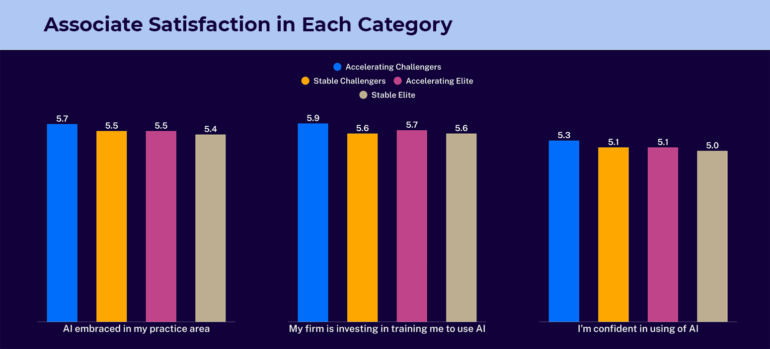
Innovation and expansion. Accelerating Challengers are more likely to be investing in AI and have teams that are confident using the technology. (The chart below shows that Accelerating Challengers are outpacing other firms in integrating AI into their operations.) They may have a distinctive operating model or be focused on expansion in a specific geographical area or specialist practice area.
Communication is another factor. Successful challengers are providing clients with clear advice and are highly responsive. They have good interpersonal skills and are easy to work with, with clients reporting honesty, kindness and a down-to-earth style.
Attracting Lateral Associates: Compete on a Credible Path to Partnership
Attracting the best talent is another important lever of success. Accelerating Elite firms score 95% higher for employer brand appeal among potential lateral associates than the top 100 average, and 50% higher than similar-size Stable Elite firms.
Lawyers seek out firms where they can access complex, high-value work for leading clients and learn from strong mentors. Demonstrating these attributes to the market, whether through top rankings, media coverage or other profile-raising activity, will help firms attract the people who sustain future success.
Law firms should also consider the opportunities they offer to ambitious associates. Partnership aspiration among associates at Elite firms is significantly lower than at Challenger firms, while flight risk is correspondingly higher. And even among those associates that do aspire to partnership, nearly twice as many associates in Elite firms see it as unrealistic.
For firms looking to attract new hires, this creates an opening to compete more directly on career opportunity by providing a more transparent and credible path to partnership.
Short-Term Tactics Are Unlikely to Move the Dial
The practical question for every law firm leader is whether your current strategy is creating momentum, maintaining position or allowing your firm to fall behind.
Leading reputations and stellar financial results are built over time. It’s not about a single impressive year, but a focused strategy that delivers sustained high-quality mandates across multiple years. Improvements in Chambers rankings, for example, typically reflect three to five years of consistent excellence. Firms whose ranking trajectory is flat should read that as an early warning sign.
The self-reinforcing advantage cycle can break down when one component of your strategy weakens. If client experience is inconsistent, or you are weaker than competitors on an important attribute such as commercial awareness or bench strength, clients slowly shift work elsewhere. If the lateral market is not aware that a firm is achieving an enhanced market position, then it will be harder to attract talent and fuel organic growth.
All firms benefit from keeping a close eye on data that shows where they stand with talent and clients, so that they can identify and invest to improve low-performing areas.
Licensed under the Unsplash+ License