

Many lawyers pride themselves on their mastery of language. They don’t hesitate to correct others. Perhaps you are among these grammar snobs. Lots of them regularly read Get to the Point.
Some common usages are actually OK, but seem to draw grammar snobs’ ire nonetheless.
Hopefully, the Jury Understood the Expert.
Grammar puritans will caution that the jury isn’t hoping anything at all. It is the person who put together this sentence who is doing the hoping. Therefore, they argue, sentences should never start this way.
“Hopefully” is an adverb. As kids, we learned that adverbs modify verbs, adjectives or other adverbs. But sometimes adverbs modify an entire sentence. When this happens, the word is called a sentence adverb. Common examples of sentence adverbs are: actually, unfortunately and presumably. Even grammar snobs have been known to use sentence adverbs this way.
The Testator Gifted the House to the Maid.
Language changes with use in many ways, including nouns becoming verbs. The best example might be “google.” There are a number of terms for this process, the most technical being denominalization. It could also be called conversion or verbing.
Modern dictionaries recognize “gift” as a transitive verb, meaning it takes an object such as “the house.” We have long used the passive verb form to say someone with exceptional talent is gifted.
Certainly, “give” continues to work perfectly well. But it’s fine to use “gift” as a verb.
The Collision Decimated the Plaintiff’s Vehicle.
Dyed-in-the-wool grammarians wince when they hear or see this verb used as a synonym for “completely destroy.” They know the history. “Decimate” originally referred to the Roman military punishment of killing 1 in 10 people for a communal infraction. Just as the prefix “deci” refers to 10, to refer to total annihilation as decimation when it can only refer to the destruction of one-tenth just seems wrong.
And yet “decimate” appeared as early as the 1660s to refer to destruction of a large part, unrelated to the one-tenth fraction. No less an authority than Bryan Garner, author of Black’s Law Dictionary, has decreed that using “decimate” to mean inflicting large-scale destruction is now universally accepted. He also notes that the only ones not accepting the transformation are pseudo-snoot eccentrics.
And There’s Another Thing.
Conjunctions connect words, phrases and clauses. Clauses, which have a subject and verb, could be sentences on their own, but an advocate might want to show a connection by joining them with one of the coordinating conjunctions: for, and, nor, but, or, yet, so. Too many such jointures produce a run-on sentence — and bores the message recipient.
Yet there is nothing wrong with using one of those conjunctions to start a new sentence. F. Scott Fitzgerald did it in “The Great Gatsby”: “And so we beat on, boats against the current, borne back ceaselessly into the past.” Hans Christian Andersen did it in “The Emperor’s New Clothes”: “But the Emperor has nothing on at all!”
English teachers traditionally forbade using a conjunction at the beginning of a sentence to prevent the creation of those run-on sentences. But your eloquent prosody may rely on that sentence structure. Go ahead.
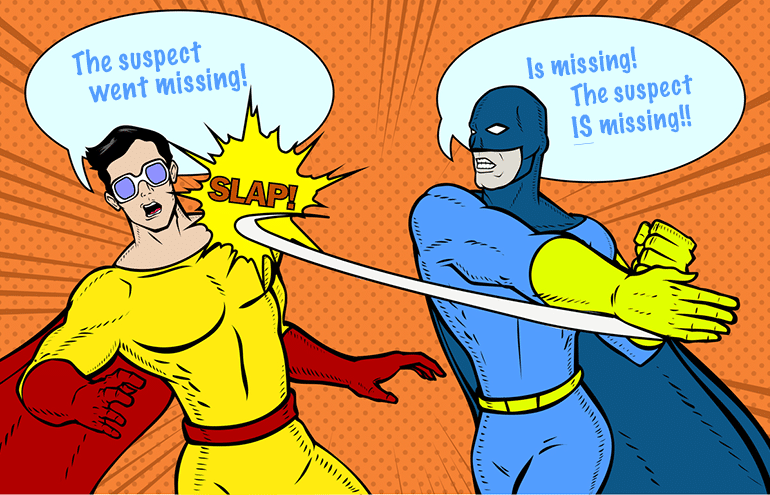
The Suspect Went Missing.
Yes, the suspect is missing. But it’s OK to use this form of the verb “to go.”
We use other versions of this construction, such as “the horse went astray.” Examples of the past tense of “go” to refer to passing into a certain condition are not unusual: The killer went mad.
Missing is also a state or condition. So, yes, a person or thing can go missing.
Grammar Snobs Are Everywhere
These usages are actually OK, but that doesn’t mean you have to adopt them. Hearing or reading these words can hurt a grammar snob’s brain.
Let’s draw the line between your inner thoughts and spoken condescension. When you witness one of these usages, grind your teeth and, unless you are signing off on an offending document, keep your corrections to yourself.
Though the phrases may be accepted now, grammar snobs may still disdain them. How many judges are closet grammar snobs? No one knows, but certainly they’re here on YouTube. Why take a chance with a usage that could distract from getting across your point?
More Writing Tips
Find more good ideas for improving your legal writing and communications skills in “Get to the Point” by Teddy Snyder.
Subscribe to Attorney at Work
Get really good ideas every day for your law practice: Subscribe to the Daily Dispatch (it’s free).
Image © iStockPhoto.com