

In “A Life in the Law,” Susan Cohodes shares pearls of wisdom from her long career in personal injury practice and her transition to “less-than-full-time” practice. This time: her thoughts on the messy NextGen bar exam in her home state.
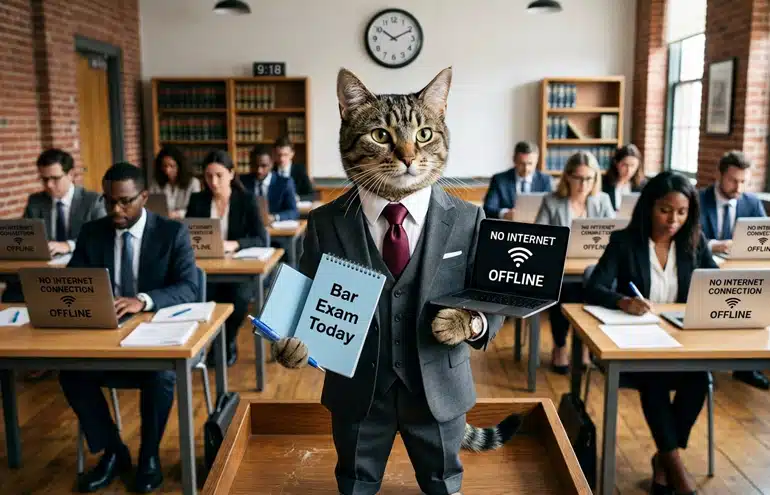
I’m usually a cranky, old-school lawyer, but a major tech snafu with the July Washington State Bar Exam has me feeling a little less cranky and a little more vindicated.
The two-day bar exam was set to begin early on July 28, 2026, in Yakima, Washington. For perspective, Yakima is east of the Cascade Mountains. More than 80% of people who live in Washington (including me) live West of the Cascades. So, many of those 600 future lawyers in Yakima for the test had booked rooms and flights and rental cars to be there. They schlepped their laptops and backup batteries and maybe even packed an old laptop … just in case.
And then the test failed. Imagine.
Afterward, the Washington State Bar Association, which administers the test, said bandwidth and connectivity issues forced the cancellation of the test for most of the test takers.
New NextGen Bar Exam Guinea Pigs
This was the first time the NextGen Uniform Bar Examination (UBE) was offered. Washington, four other states and several territories were the Guinea pigs.
The National Conference of Bar Examiners (NCBE) has been working on improving and streamlining the uniform bar exam for the past eight years. More than 40 other jurisdictions are adopting the new text, to be rolled out between July 2026 and July 2028.
The tests were fine in the other locations, but not in Yakima.
Test takers knew something was amiss as more and more of them signaled that they were having connectivity issues. They were stuck in test rooms for several hours while administrators decided what to do. In addition to being angry and frustrated, they also left the test site hungry, since they were not allowed to leave for lunch for several hours. Test takers who had been granted accommodations were able to complete the test, but most test takers left without knowing when they could sit for the exam that would allow them to get licensed and start their jobs.
As I write this, the Washington State Supreme Court has decided to grant diploma privilege licenses to those test takers who had not been granted accommodations and had not failed a previous bar exam or who were not licensed in any other state, provided they passed the ethics exam and met character and fitness standards.
Test takers who were eligible for diploma privilege licenses were also given the opportunity to sit for a substitute exam on September 1 and 2 if they wanted a license that would be acknowledged by other states. Those who were not eligible for the diploma privilege license will be able to credit their payments for the July exam toward the February 2027 exam.
(Of note, the first time I went on the WSBA website to look at the Court’s order, the link didn’t work — and it was not operator error.)
It seems to me a minor miracle that, unlike the California test-takers who faced similar “technical difficulties” last year, as far as I have seen, none of the 600 or so examinees have filed a lawsuit for negligent infliction of emotional distress or, at the very least, for reimbursement of non-refundable hotel or rental car charges.
That may change this month, when the state releases the results of the July and September tests, for those who chose to take it. Any test taker who was granted accommodations and who doesn’t pass could certainly find a clever lawyer to file a lawsuit using the rarely used theory of “Hey, wait a minute, I want diploma privilege too.”
In summary, it was a gigantic mess.
What was not a mess when I took the Illinois bar exam in 1986 and the Washington bar in 1993? My test. For each exam, I came fully prepared with a can of Diet Coke, 24 erasable ink pens and five big pink erasers. As I recall, I used exactly one pen for each test, but if any of those pens had failed, I was ready and would have completed the test anyway.
I guess if there had been a fire and the blue books they gave us in Illinois, or the legal-sized answer sheets they gave us in Washington, had burned in storage the night before the test, the Supreme Courts of each state would have faced the same disaster. Still, this year in Washington, the opportunity for a snafu was, I think, far greater: All that had to happen was the Wi-Fi conking out.
Reconsidering Pen and Paper After the July Bar Exam Disaster
So, as a cranky, old-school lawyer, I declare victory for the old ways. It seems law schools are taking notice, too. The University of Chicago, UC Berkeley, UT Austin and now Columbia have all instituted policies to decrease the use of laptops and other devices in classes or on tests, bringing students back to paper. Of course, concerns about artificial intelligence and cheating are driving the schools’ actions, since proctoring software on laptops is tricky. (LawSites reports on the University of Chicago’s AI policy here.)
But there is also acknowledgment that some traditional methods of teaching and testing are worth keeping. Like writing by hand.
Writing Is Thinking
I’m no Luddite. But as a cranky, old-school lawyer, I believe the act of writing and notetaking by hand (and in the case of papers or student briefs, writing and writing again and again) helps students hone their writing skills and develop their critical thinking skills in ways that typing, transcribing and cutting and pasting simply cannot.
(For the science behind this, read “Why Writing By Hand, and Slowing Down a Little, Improves Your Performance” here on Attorney at Work.)
When I talk with clients, I take much better notes by hand when I have to do some editing in my head, because I simply cannot write as fast as they can talk. I can also listen more closely when I’m not typing, and get to the right follow-up questions as they come up. On the rare occasion when I take notes on my laptop, I am mostly just transcribing with little thought or editing since I can type as fast as my clients can talk.
Old-School Hero
When I first moved to Washington some 30 years ago, I met a lawyer who always sat at the very front during CLE’s, with his little bottle of ink and fountain pen. He seemed really old, but it turns out he was not that much older than me. Now he is my hero, and if I ever attend a CLE in person again, I will look for him and maybe chat about the resurgence of old school.
Until then, I think I will put a soothing album on my turntable, open a riveting paperback and bask in the fact that some things old seem to be new again.
More Life in the Law
- A Career in Personal Injury Law, If You Can Take It
- Beam Me Up, Scotty: Is My Lawyer Personality Stuck in the Past?
- In and Out of the Firm, Part-Time Law Practice Is Feeling Awesome
- Lessons From Year One: The Less-Than-Full-Time Lawyer Life
- Do I Have To? Advice for Law Firm Interns on How Not to Annoy the Senior Lawyer
- The Most Important Thing About Being a Less-Than-Full-Time Lawyer
- Semi-Retired: Breaking Up Is Hard to Do
- An Antidote to Ungrateful Clients: Rediscovering the Satisfaction and Joy of Helping Others
- The Key to Having It All as a Full-Time Lawyer Mom
- The Countdown Begins: Farewell to Full-Time Law Practice
- What to Wear? Pantless in Seattle
- Retiring from Law Practice: Should I Stay or Should I Go?
Image © iStockPhoto.com.

Sign up for Attorney at Work’s daily practice tips newsletter here and subscribe to our podcast, Attorney at Work Today.