

Abraham Lincoln’s philosophy as a trial lawyer is a roadmap not just for attorneys, but for any expert witness who has ever taken the stand. This is my tribute to the man who taught me the true value of integrity in expert testimony.
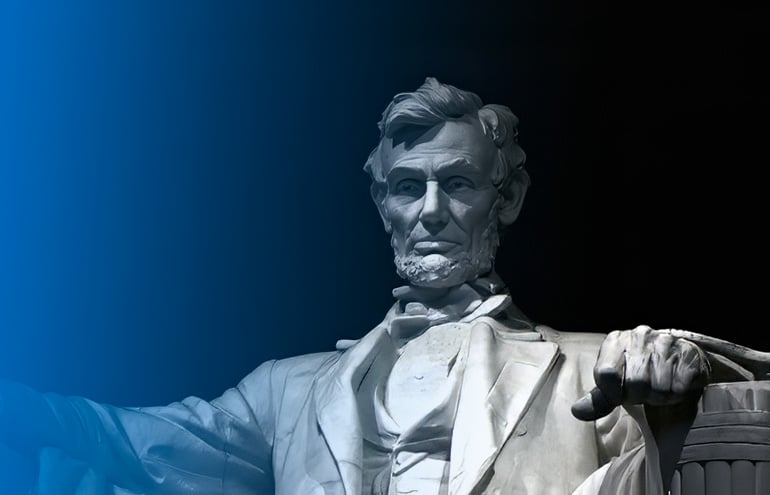
Abraham Lincoln wasn’t a dentist, nor was he an expert witness. Yet, as a dental expert witness, no figure in history has influenced my professional philosophy more than Lincoln. His legal ethics, storytelling and commitment to truth resonate in my courtroom work more deeply than even the most influential mentors in my field.
A Role Model for Expert Witnesses
Before he was president, Lincoln was arguably the most respected trial lawyer in Illinois. He took on over 5,000 cases during his legal career — ranging from murder defenses to land disputes — and was known for his command of logic and decency in the courtroom.
As an expert witness, I have no partisan role. I don’t argue the law, I explain the science. But Lincoln’s approach shapes how I do that. He prepared thoroughly for every case, reasoned sharply, and always led with fairness. Because each case could change someone’s life for better or worse, I approach depositions and testimony with the same values. When I write an expert report, I imagine I’m presenting it to Lincoln himself — a man who could spot exaggeration and nonsense from a mile away.
The Lincoln Way: Lessons on Integrity
Lincoln had no problem turning down cases that required him to distort the facts or manipulate the truth. He believed in presenting a case honestly, even if it meant losing. In one murder trial, Lincoln withdrew after concluding that his client was guilty.
In another case, he was representing a plaintiff in a debt collection case. However, when he realized the evidence contradicted his client’s position, he deliberately stayed out of the courtroom. When the bailiff came to bring him back, Lincoln declined, saying, “Tell the Judge I can’t come. My hands are dirty, and I came over to clean them.”
The judge dismissed the case and summed it up with just two words: “Honest Abe.”
That’s a rare ethic in any profession, but especially when maintaining integrity in expert testimony, where pressure can come from interested parties to “lean” a certain way or shape an opinion to fit a particular narrative. In my work, I always turn to Lincoln’s words:
“Resolve to be honest at all events; and if in your own judgment you cannot be an honest lawyer, resolve to be honest without being a lawyer.”
For me, it means never accepting a case that would require me to compromise my morals or professional integrity. That’s the Lincoln way.
Clear Communication
Be it inside or outside the courtroom, Lincoln’s speeches were famous for their simplicity. He explained complex ideas in a way that ordinary jurors could understand. As a dental professional, it’s easy to get lost in anatomical jargon or statistical details. But clarity is everything.
I often recall Lincoln’s warning against overcomplication:
“Never use a long word when a short one will do.”
For instance, saying something like “bilateral subcondylar fracture with mild sagittal displacement” would certainly confuse anyone who is not in the dental or medical profession, which most jurors won’t be. Instead, I would simply say: “Both sides of the lower jaw were cracked and shifted slightly.” Effective communication isn’t about sounding smart; it’s about being understood by your audience.
The Power of Preparation
Lincoln once said, “Give me six hours to chop down a tree and I will spend the first four sharpening the axe.” A perfect example where he demonstrated his commitment is the 1857 case of Johnston v. Jones and Marsh, a long-running federal land dispute over a new stretch of land created by rerouting the Chicago River. Lincoln put his background as a former surveyor and experience in property and waterway law to work.
By the time he joined the case, it had already been tried multiple times over more than a decade. But when the trial resumed in 1860, Lincoln did what few attorneys would. He visited the disputed site himself, took measurements, and immersed himself in the physical details. This paid off in the courtroom. During cross-examination, Lincoln calmly and precisely exposed the surveyor’s lack of accuracy. Without grandstanding, he asked simple, direct questions that revealed the surveyor hadn’t actually measured the critical boundaries he claimed to map.
Lincoln didn’t allow the witness to speculate or editorialize. He focused on hard facts, using his own knowledge to uncover carelessness in the expert’s work. That precision helped persuade the judge to instruct the jury to disregard the flawed survey, ultimately leading to a verdict in Lincoln’s favor. Even more telling, the case later went to the U.S. Supreme Court after Lincoln became president, and the verdict stood.
In my line of work, preparation may include reviewing dental X-rays pixel by pixel, studying patient histories, treatment and timelines, and anticipating how opposing counsel might question every conclusion I draw. I sharpen my expert opinion with hours of analysis, peer-reviewed studies, and mock cross-examinations.
I’ve learned that the quiet work before the courtroom is what earns you trust inside it, and upholds the standard of integrity in expert testimony.
Related: Mistakes Lawyers Make When Procurring Expert Witnesses.
Humility and Humor in the Courtroom
Lincoln was funny. Not to mock, but to disarm. He could lighten a courtroom without undermining it. In one case, the outcome hinged on a medical expert whose testimony was often solid. After the doctor took the stand, Lincoln began his cross-examination with this question: “Doctor, how much money are you to receive for testifying in this case?”
The doctor hesitated and asked the judge if he had to answer that question. The judge said yes. The doctor then named a fee so large it left the jury stunned. Lincoln then said, “Gentlemen of the jury, big fee, big swear!” That brief, cutting remark was enough. Lincoln had cast doubt on the doctor’s credibility, swaying the jury to his side. As recounted in “Lincoln Talks: A Biography in Anecdote,” he won the case.
I once faced an attorney who tried to challenge my credentials by joking, “So you’re the tooth fairy with a Ph.D.?” I paused, smiled and replied, “Only if the tooth fairy works with X-rays and testifies under oath.” The courtroom chuckled, and we moved on.
Lincoln taught me that a little wit, delivered with humility, can level the playing field. Lincoln never took himself too seriously, but always took the law seriously. That’s my goal, too.
Expert Witness Work as Public Service
Lincoln’s sense of public service went beyond personal ambition. He saw his legal career as a way to help people navigate complex systems and seek justice. I have also come to view my work in the same way.
Yes, I get paid. But more than that, I help the court make sense of information that is presented before it. My testimony might prevent a wrongful conviction, help a victim get justice, or simply bring understanding to something that seems incomprehensible.
Lincoln once wrote:
“The leading rule for the lawyer is diligence. Leave nothing for tomorrow which can be done today.”
I aim to apply that same diligence in every case. Because, ultimately, integrity in expert testimony work is more than data; it’s public trust.
In every deposition, every courtroom, and every expert report I write, Abraham Lincoln is there in principle. His straightforward communication shapes how I speak. His ethics guide how I choose cases. His humility keeps me grounded. His courage reminds me to stand firm when it matters.
To most people, Abraham Lincoln is a former president. To lawyers, he’s a role model. To me, he’s both, and more.
Related: A Crack in the Case: Legal Analytics and the Search for Expert Witnesses.
Image © iStockPhoto.com.

Sign up for Attorney at Work’s daily practice tips newsletter here and subscribe to our podcast, Attorney at Work Today.