

In the latest edition of her creativity and productivity series, Karen Skinner shares new research on the true cost of lawyer burnout. Could investing in rest and recovery actually increase your firm’s revenue?

Highlights
- Invisible Bottom-Line Hit: What’s called presenteeism accounts for nearly 70% of the total costs associated with poor lawyer well-being.
- Operational Debt: Skipping recovery doesn’t eliminate fatigue — it compounds and eventually manifests as costly mistakes, slow decision-making and high attrition.
- Micro-Recovery Works: Restoring mental clarity doesn’t require taking weeks off work. Consistent, small doses of creative rest measurably reset cognitive capacity.
A good personal trainer will tell you it’s important to build rest days into your workout regimen. You know that without recovery time, you won’t see the results you’re seeking. But ask most firm owners about rest and recovery, and you’ll probably get a shrug. Recovery feels personal, maybe even a little indulgent. Working time has a dollar value attached to it. Rest doesn’t, or at least not one anyone bothers to calculate.
But rest does have a cost, albeit usually unseen.
The True Impact of Exhaustion: What Burnout Really Costs Your Firm
I’ve written before about operational debt, the idea that decisions you put off don’t disappear; they just compound in the background and become even more expensive to resolve. The same principle applies to recovery. Skipping rest doesn’t make the need for it go away, and eventually you’ll pay the price: a slow erosion of mental health, decision quality, patience and performance.
A 2024 survey of over 4,400 lawyers in the United States and the United Kingdom put real numbers to the cost of exhaustion and stress. Nearly 1 in 5 lawyers said their work actively harms their mental health. On top of that, poor mental health affects the time they do spend at work, a phenomenon researchers call “presenteeism”: being physically at your desk while your actual capacity to think, decide and perform is significantly diminished.
Why Presenteeism Is Costlier Than Absenteeism
Across the firms surveyed, poor lawyer well-being cost millions of dollars annually in lost productivity, absenteeism and attrition (more than 10% of total staffing costs). Presenteeism alone accounted for close to 70% of the total costs associated with poor well-being.
Read that again slowly: Most of the financial impact of poor well-being comes from employees who are present, logged in and billing hours, simply because their capacity to think clearly is compromised.
It turns out the greatest impact of burnout isn’t absence. It’s lawyers and staff who come to work every day at reduced capacity. They’re slower to make decisions, quicker to snap at colleagues, and more likely to miss something that a rested person would have caught immediately.
You can’t see that kind of reduced capacity on a financial statement, but it’s an invisible cost the firm is constantly absorbing, whether or not anyone has spotted it.
Reframing Recovery as a Capital Investment
When you think about rest and recovery like this, it stops being a nice-to-have. Rest is a firm-level investment that deserves the same attention as maintaining equipment or retaining good staff. Skipping recovery doesn’t make you more productive. It makes it more expensive to keep running. And if you’re in a leadership position, the impact will be felt across your firm.
Protecting Your Bottom Line with Micro-Recovery
Luckily, real recovery — the kind that actually restores your capacity to think clearly — doesn’t require large blocks of time. As I said in my earlier article here on creative practice, consistent creative rest, even in small doses, changes the equation measurably. The cost of skipping rest may be cumulative, but fortunately, so is the benefit of protecting it.
If you’ve been treating your own recovery as the least important item on your to-do list or the thing you cut first when you get busy, consider this your invitation to move it up the priority list. You deserve a break. Your firm is paying for it either way, and right now, it’s paying the higher price.
The Cost of Lawyer Burnout FAQs
Catch up on Karen Skinner’s Creativity and Productivity Series
“The Law Firm Productivity Myth That’s Burning Lawyers Out”
“Why Your Brain Needs Creative Rest (and What That Actually Looks Like)”
“Did You Know Being a Terrible Guitar Player Could Make You a Better Lawyer?”
“Restore Your Energy and Productivity — Five Minutes at a Time”
“Why Creativity Is a Leadership Skill, Not a Hobby”
More Healthy Lawyer Productivity Tips
- Micro-Recovery: 5 Small, Realistic Ways to Reduce Stress During a Busy Workday
- How Doodling Makes You a Better Listener (and 3 More Benefits)
- Delegation Isn’t Just a Work Hack, It’s a Life Hack: 5 Personal Tasks to Delegate Now
- Got a Process for Your Processes? Create Law Firm SOPs in 5 Easy Steps
- Why Lawyers Need Boredom
- Indoor Fitness Tips for Attorneys With Busy Schedules
- Why Are You at the Office Until 10 p.m.?
- Top-Rated Mindfulness and Meditation Apps
- How to Be Productive When You’re Depressed
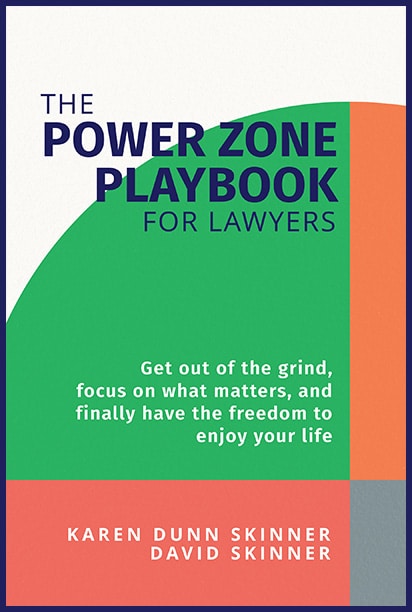
Get the Power Zone Playbook for Lawyers
By Karen Dunn Skinner and David Skinner
Get out of the grind and into your power zone! Learn to align the work you do with the work you love, finding the sweet spot where your expertise, passion, and client needs intersect. It’s here, in your Power Zone, that you will discover the secret to a thriving practice.
Everything you need is in your Playbook.
Images © iStockPhoto.com