When you approach retirement as a lifelong adventure, it can be a constant source of rejoicing. Here’s how design thinking gets you there.
Retirement can be celebrated as an event or a status. As an event, retirement is pretty quick and easy. The type of event depends on the nature of your position, company and tenure. It might be a potluck lunch where co-workers praise your years of service and give you a card signed by everyone in the office. Or, if your role is more significant, it might involve a formal dinner with speeches lauding your contributions and legacy and the gift of a gold watch.
Regardless of the event, your retirement status or standing in the world will be more long-lasting and harder to define.
You will be the same person after you retire but the way others perceive you will change.
The career you enjoyed, which took most of your time and formed much of your identity, is in the past. You will be a “former” lawyer, engineer, teacher or CEO. And you will be reminded of your new status every time someone asks you what you do, and you answer, “I used to …”
This can be disheartening — unless you replace the old status with a new one that keeps you engaged, stimulated and happy.
A More Constructive Way to Think About Retirement
To most people, “retirement” suggests withdrawal, irrelevance and cessation, but there is a better way to view it. The Spanish term for retirement is “jubilación,” or a cause for rejoicing. And that is a far healthier and more constructive way to think about retirement. This is the time you can do the things you enjoy and decline the things you don’t. You can travel, go to school, work for pay, or volunteer for a cause you feel passionate about. You can explore the things that interest or intrigue you or that you’ve never had time for.
Rather than a “has-been,” you can be an explorer, activist, entrepreneur, student, storyteller — or whatever suits you best.
With a positive outlook and a sense of adventure, you can define retirement on your own terms and create a new status that is as — or more — meaningful and fulfilling than the one you enjoyed during your career.
Design thinking is a method of creative problem-solving.
Design thinking inspires you to expand your thinking, find and try new ideas, and create an innovative and flexible roadmap to the future. It helps you address uncertainties, risks and constraints — and discover possibilities that you may not know exist.
Five Stages of Design Thinking
Design thinking is a dynamic, fluid and ongoing process. It involves five stages, but you do not have to follow them in any particular order. You can work in two or more stages concurrently, and you can repeat stages whenever and as often as necessary to arrive at the best plan for you. Here are the five design thinking stages:
Empathy. Reflect on your desires, wants and needs. What has made you happy in the past? What will make you happy in the future?
Definition. What would a happy retirement include? Challenge assumptions (your own and others’) about what you should or shouldn’t do or what you can or can’t do. Instead, focus on what you want to do.
Ideation. Envision your ideal future. Brainstorm ideas for the happy life you envision and come up with different scenarios and components.
Prototyping. It isn’t enough to have ideas, even if you write them down. Try out your ideas. Experiment. Sample the possibilities you generated in stage three. Interview people, volunteer, take courses, intern, shadow someone, do anything you can that will help you determine whether an option that sounds good will, in fact, be a good fit for you.
Testing. Once you have tried something out, decide whether it is right for you as it is, whether you want to refine it and continue, or whether you want to drop it and start over again with something else.
Like retirement, this design thinking approach is open-ended and subject to change and surprise. Unlike a planning process that starts with a specific goal to work toward, design thinking allows you to discover possibilities, adapt to changes in your life, and develop different goals and plans as you go. You can try things out and change your mind. You can repeatedly reflect on your experiences, redefine desired outcomes, create new ideas, test and refine until you achieve the best retirement possible. You can do all this because one of the nicest things about retirement planning is that there’s no hurry; you can take your time and move at the pace you desire.
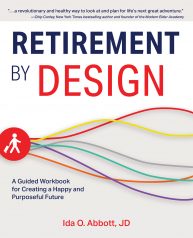
BOOK REVIEW | “Facing retirement can be a challenge. Ida Abbott has made it easier with her book ‘Retirement by Design: A Guided Workbook for Creating a Happy and Purposeful Future.’ This is not another tome with logical arguments in favor of retirement, coupled with an appendix of forms, though those books can be extraordinarily helpful. Instead, Abbott has created a guided workbook that helps you chart your unique path to retirement. Abbott’s guide uses the concepts of design thinking. According to Abbott, “Design thinking inspires you to expand your thinking, to explore new ideas, push past obvious solutions, and create an innovative and flexible roadmap to the future.” — Camille Stell
Ida O. Abbott is a leader in the field of talent management. She has enjoyed a four-decade career as a lawyer and consultant and now applies her talents to help firms improve retirement processes and to serve senior professionals as a retirement mentor and coach. The Wall Street Journal named her book “Retirement by Design” one of the best books of 2020 on retirement and aging. She is a Fellow of both the American Bar Foundation and the College of Law Practice Management. She is the author of numerous seminal books, including “The Lawyer’s Guide to Mentoring, 2nd Edition” and “Sponsoring Women: What Men Need to Know,” and is a popular speaker. Learn more at www.IdaAbbott.com.
The NextGen Bar Exam tech snafus in Washington left hundreds of future lawyers stranded. Read why one self-described "cranky, old-school lawyer" believes the classic blue book still reigns supreme.
You can expect your newsletter soon. Meantime, don’t miss out on the latest information AttorneyatWork.com has to offer. Thank you!
We utilize cookies to tailor content and advertisements, offer social media functionalities, and analyze traffic on our website. Additionally, we share details regarding your site usage with our social media, advertising, and analytics associates. They may integrate this information with other data you have supplied to them or that they have gathered from your utilization of their services.