


Trial attorney Miles Feldman offers practical advice on mindfulness for trial lawyers, focusing on how to manage stress and maintain composure in high-stakes, high-conflict situations.

Table of contents
The Missing Piece of Trial Training
Trial lawyers are trained to think quickly, perform and speak powerfully. What’s largely absent from that training is how to manage your internal state in the middle of high-conflict situations. That omission becomes obvious the first time you step into a courtroom where the stakes are real and the pressure is constant. That gap is where mindfulness became relevant for me.
Long before it entered the mainstream, I began exploring meditation as a way to manage the demands of litigation. Over time, that interest developed into a more structured practice, including formal training at meditation centers and foundations like InsightLA, where the focus is on practical techniques grounded in attention, how easily it drifts, and how to bring it back.
The Anchor: Mindfulness for Trial Lawyers in Action
What began as a way to manage stress evolved into a framework I rely on every day. At the center is something simple and always available: the breath. In moments of acute stress, during a difficult cross-examination, contentious negotiation, or even an unexpected turn in court, the body reacts immediately. Your heart rate rises. Muscles tighten. Attention narrows. That response can be useful in certain contexts, but in a courtroom it often works against you. Mindful breathing, such as “box breathing” (used by Navy SEALs), provides a way to reset. Attention to breathing, even for a short time, shifts your emotional state and physiology.
Box Breathing for Immediate Composure
Here is the basic approach: a controlled inhale through the nose for four beats, hold for two to four beats, then slowly and deliberately exhale for four beats to complete the “box.”
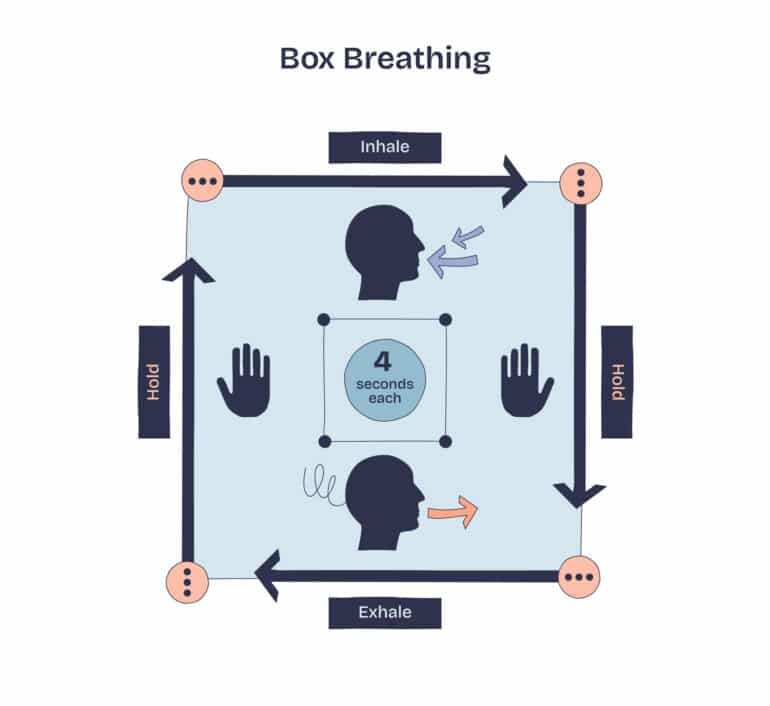
This immediately helps settle your nervous system and restores a baseline level of clarity. That margin is often all you need. It creates a small gap between what’s happening and how you respond. No one else sees it. There’s no outward signal. But internally, it changes the quality of your attention. Instead of reacting to what’s happening, you’re able to engage with it.
Consistency: Building Long-Term Mindfulness for Trial Lawyers
Those shifts matter in trial work, when outcomes hinge on timing and judgment. Push a point at the wrong moment, or miss a cue, and the dynamic can turn quickly. Once it does, it’s difficult to recover. Composure allows you to read the room more accurately and adjust in real time. Over the years, I’ve found that these adjustments are only as reliable as the habits behind them. A single technique can help in a tight moment, but consistency is what makes it available when you actually need it.
Apart from “box breathing,” creating a daily meditation practice provides a real boost to your mental and physical well-being. I have had a daily meditation practice for the last 30 years. The benefits are hard to overstate. Things just get easier to handle — no matter how hard. It allows me to be more present and mindful of all of the things happening around me without getting reactive.
A Practical Tool for High-Stakes Lawyering
A practice will strengthen your ability to stay present when it matters. You start to recognize the early signs of stress before it fully takes over. You catch reactions before they turn into decisions. You become more deliberate in how you respond, which, in this line of work, is often what matters most. It also changes how you recover. Without a reset, stress accumulates. With one, it has somewhere to go.
Mindfulness, as I use it, is not abstract. It’s practical and immediate. It’s a set of tools that can be applied in real time. It doesn’t require stepping away from the work. It integrates into it. That perspective has shaped how I approach teaching these techniques at our firm and in continuing legal education programs. The emphasis is on utility, what can be used immediately, in a courtroom, a conference room, or any setting where the stakes are high and the margin for error is narrow.
Composure as Competitive Leverage
There’s increasing recognition within the profession that technical expertise, while essential, isn’t enough on its own. The ability to stay focused and regulate emotion is what allows that expertise to hold up when it counts.
Integrating mindfulness into your daily routine ensures that your technical skills aren’t sidelined by a “fight or flight” response.
A lawyer who can stay composed has a clearer view of what’s actually happening. They listen more carefully and make more precise decisions. In a profession defined by conflict, that steadiness becomes a form of leverage.
And beyond the courtroom, it carries over into everyday life. The same skills apply in conversations, negotiations and moments of uncertainty. The context changes, but the underlying dynamic does not. Composure is not an inherent trait. It’s something that can be developed, reinforced, and relied upon. It starts with attention, often with something as simple as the breath, and builds from there.
For trial lawyers working in environments where pressure is constant and expectations are high, that ability makes a measurable difference. And in my experience, it’s one of the few advantages that’s entirely within your control.
Image © iStockPhoto.com.

Sign up for Attorney at Work’s daily practice tips newsletter here and subscribe to our podcast, Attorney at Work Today.