

The kind of work lawyers do requires deep, effortful thinking — the kind of always-on thinking that can easily deplete cognitive resources. Continuing her series on the connection between creativity and productivity, Karen Skinner explains why lawyers need creative rest.

Processing, Processing, Processing
How do you decompress after a hard week? For most of us, it’s some version of the same thing: sleep in, watch a little TV. Maybe scroll through your phone, genuinely trying to turn off your brain. But you may not feel much better for it.
Why? Because while they sound like “rest,” those things are not actually restful for your brain.
The kind of work lawyers do—analyzing, problem-solving, decision-making, managing risk—requires deep, effortful thinking. The constant mental load depletes your cognitive resources, a process researchers call ego depletion. When that happens, passive activities like watching a screen or scrolling social media just fill the space without restoring it. Your brain continues processing information and absorbing stimuli and never shifts out of activation mode.
What Your Depleted Mind Needs Is Something Different: Creative Rest
Creative rest isn’t a spa day or an extended vacation (although I wouldn’t say no to either of those after a hard week). Rather, it’s what happens when you engage in a low-stakes, absorbing activity that’s fundamentally different from legal work. It could be cooking or gardening. It might be journaling, building something, or learning to play guitar. For me, it’s painting. The specific activity doesn’t matter. What does matter is the shift in how your mind is working.
Activities like this trigger your brain’s default mode network — the same network associated with daydreaming, reflection and what researchers call incubation. In this state, your mind processes complex problems in the background, makes lateral connections between seemingly unrelated ideas, and generates the kind of insight that doesn’t come from re-reading a brief 17 times. It’s the reason you come up with a brilliant solution to a problem while you’re in the shower, or why the right words for a difficult clause pop into your head while you’re weeding the garden. In my case, it’s why my best ideas come when I’m standing in front of my easel or sitting in my kayak.
It happens to all of us, and it’s not random. It’s what your rested, unforced brain does when you give it space.
The Antidote to an Empty Tank
Lawyers are trained to work hard. We learn early that the answer to most problems is more effort, more time and more concentration. That instinct serves us well in many situations, but it doesn’t help when our cognitive resources are depleted. At that point, pushing harder produces diminishing returns: slower thinking, more mistakes, and the generalized irritability that comes from trying to function on an empty tank.
Creative rest interrupts that cycle. It gives your analytical mind a break while keeping enough of your brain engaged that you don’t drift into passive stimulation. It’s the difference between genuinely recharging and simply stopping.
One of the most common objections I hear is “I don’t have time for that.” I get it. Law practice doesn’t leave a lot of margin. But creative rest doesn’t require hours. Research on micro-breaks consistently shows that short, voluntary pauses involving a creative or absorbing activity — even five to 10 minutes — lead to measurably improved concentration, reduced fatigue and better performance on the work that follows.
My 100-Day Creative Challenge
I do a 100-day art challenge every year: 100 days in a row where I paint for however long I can manage. Some days that’s an hour; most days I squeeze in 15 minutes or less (and I invariably lose count or miss a day, but I don’t beat myself up over that). Even when I only spend a few minutes in my studio, the results are obvious: On days when I paint, my focus improves, my mood lifts, and I do better work.
The benefits scale up with more time, but they don’t require it.
You also don’t need to be good at what you do. Perfection is not the point. The point is the shift: moving your brain into a different mode, giving your analytical self a rest, and creating the conditions for insight and recovery to happen. I can’t count the number of clients who have said they solved a complicated problem while cooking dinner, or came up with the perfect argument in the middle of a hike.
Their brains didn’t stop working; they simply started working differently.
If you already have a creative practice, great! Prioritize it. It’s not a luxury you earn after your “real” work is done. It is how you do the real work well.
Take 5 Minutes to Be Creative
If you don’t have a creative practice or hobby, start small. Take five minutes this week to do something creative. Not productive, not perfect, just purely creative.
- Write something for yourself.
- Doodle on a legal pad.
- Try that recipe you’ve been meaning to make.
It doesn’t have to be impressive or polished or even finished because your goal isn’t the output. It’s the recovery.
And for a profession that runs on cognitive performance, creative rest isn’t optional. It’s strategy.
Photo by Alice Dietrich on Unsplash
More Healthy Law Firm Productivity Tips
- The Productivity Myth That’s Burning Lawyers Out
- Micro-Recovery: 5 Small, Realistic Ways to Reduce Stress During a Busy Workday
- How Doodling Makes You a Better Listener (and 3 More Benefits)
- Delegation Isn’t Just a Work Hack, It’s a Life Hack: 5 Personal Tasks to Delegate Now
- Got a Process for Your Processes? Create Law Firm SOPs in 5 Easy Steps
- Why Lawyers Need Boredom
- Indoor Fitness Tips for Attorneys With Busy Schedules
- Why Are You at the Office Until 10 p.m.?
- Top-Rated Mindfulness and Meditation Apps
- How to Be Productive When You’re Depressed
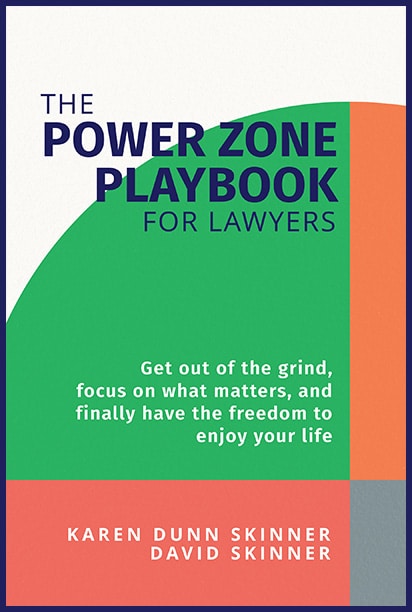
Get the Power Zone Playbook for Lawyers
By Karen Dunn Skinner and David Skinner
Get out of the grind and into your power zone! Learn to align the work you do with the work you love, finding the sweet spot where your expertise, passion, and client needs intersect. It’s here, in your Power Zone, that you will discover the secret to a thriving practice.
Everything you need is in your Playbook.
Images © iStockPhoto.com