

Lawyers have the same rights and responsibilities as everyone else. As a “Joe Average” citizen, my responsibility and impact come with what I do with my feet, my voice and my wallet. But we also have professional responsibilities to weigh when participating in protests or boycotts.

Key Takeaways
- Blackouts are a strategic protest: An economic blackout is a peaceful, planned strategy where participants limit work and spending to demonstrate how much the system relies on the “Joe Average” citizen.
- You don’t need 90% participation: According to researcher Erica Chenoweth, nonviolent campaigns need only 3.5% of the population to succeed, showing that collective action by a committed minority can compel change.
- Impact is immediate and aggregate: Because consumer spending drives 68% of the U.S. GDP, pulling money out of the system — even temporarily — shows results quickly across retail, food and entertainment industries.
- Spend locally: The blackout strategy encourages participants to shift spending from big-box stores to local businesses, which has a stronger, positive net impact on the community.
- Sometimes silence speaks loudest. As an attorney, your actions can inspire others.
The Responsibility of the Educated: A Revisit
When I was 17 years old, I spent part of the summer before starting college applying to the Honors College at Oregon State University. The application included three essay questions, one of which was, “What is the responsibility of an educated person?”
This question baffled me. The responsibility of an educated person is the same as that of an uneducated person: Do the best you can with the knowledge and resources that you have. An educated person may be in a position to do more in certain circumstances, but the overall responsibility remains the same; I answered the question accordingly.
Did I get in? Yes.
Is that the point? No. Keep reading.
Growing up in the U.S., the importance of voting was instilled in me at a young age. For every right, there are corresponding responsibilities. As such, the right to vote comes with the responsibilities of being an informed voter and casting your ballot on time. Sometimes, who wins in an election comes down to a single vote.
When someone holds an elected position, they literally have a temp job that’s contingent on how well they serve and represent their community. Likewise, part of our obligation as members of the community is to tell our leaders what we need and to challenge them when we think they’re doing something wrong. As Michael J. Fox’s character Lewis Rothchild said in the 1995 film “The American President”:
“[I]n this country, it is not only permissible to question our leaders, it’s our responsibility!”
Exercising Rights, Fulfilling Responsibilities: The Attorney’s Dual Role
Lawyers have the same rights and responsibilities as everyone else.
As a non-binary person who opposes banning books, supports free speech, I also believe that:
- All genders deserve equal rights (including to bathrooms and in athletics).
- Medical decisions should be made by the patient and their doctor based on scientific evidence.
- All children deserve a quality K-12 education — including lunch.
- Rapists belong in jail.
- Gun violence is a problem in our country.
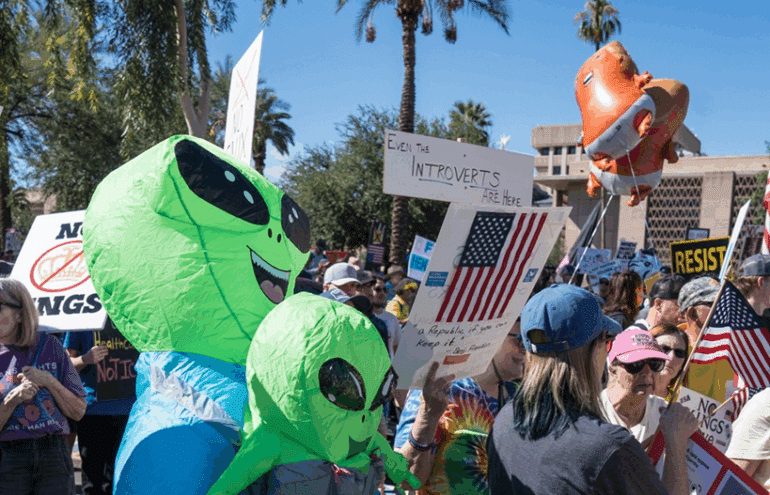
I disagree with most decisions made by the federal government this year and, by extension, the decisions many companies and organizations have made to align themselves with the views of the executive branch. As a Joe Average citizen, my responsibility and impact come with what I do with my feet, my voice and my wallet. As such, I am participating in several ongoing boycotts, including those against Target and Amazon; I participated in my local “No Kings” protest on October 18; and I participated in multiple economic blackouts this year.
Is that me in the photo with a whiteboard on a stick? Yes. I’ve had it for years and used it at many events. It’s much more convenient than a single-use posterboard.
How have I handled my dual roles as an advocate for my clients and an advocate for social change? Again, keep reading.
What an Economic Blackout Really Is: A Strategic Refusal
An economic blackout is a strategic and peaceful protest that demonstrates how a united group of people can yield tremendous power together. For the duration of the blackout, to the extent they can, participants do not spend money and do not work. If a participant needs to buy something, if possible, they patronize a locally owned business instead of a big-box store and use cash.
Not everyone has the ability to participate in an economic blackout because if they don’t work, even one day, they cannot provide for their families. It’s understandable and sad that some people’s financial situations are too precarious. However, they may still abstain from spending money, and they can spread the word so others will participate.
As an of counsel attorney, I’m affiliated with a law firm, but I have total freedom regarding when and where I work. This makes me an ideal person to participate in this type of protest, assuming I don’t have a court appearance or other unavoidable client obligation.
The 3.5% Rule: Why Collective Action Works
Here’s what history (and 2025) shows us about collective action.
Women in Iceland did this on October 24, 1975, and it changed how the country viewed their power. On that day, 90% of the country’s women did not do any work in the home or at jobs. As a result, schools and banks could not open, and buses could not run. These women showed that when they removed themselves from the system, the system could not function.
While the majority of women participated in the Icelandic women’s strike, a boycott does not require 90% participation to be successful. According to Erica Chenoweth, political scientist at Harvard University, “No government can withstand a challenge of 3.5% of its population without either accommodating the movement or (in extreme cases) disintegrating.” Additionally, her research showed that nonviolent protests are twice as likely to achieve their goals as violent campaigns.
Indeed, we saw how quickly a protest by Joe Average American citizens can instigate change. ABC removed “The Jimmy Kimmel Show” from the air in September 2025 after the chair of the Federal Communications Commission threatened to revoke ABC’s broadcast license in response to Kimmel’s statements about the administration.
Disney owns ABC and Hulu. In protest of Disney’s decision to remove “The Jimmy Kimmel Show” from the air, over 1.7 million people reportedly canceled their Disney streaming subscriptions, and Disney’s stock dropped by about 3%, wiping out — $6.4 billion from the company’s valuation. Hulu’s cancellation rate was also twice as high compared to the two prior months (10% versus 5%).
Seven days later, Disney reversed course and Kimmel’s show was back on the air, showing the power of people protesting with their wallets.
National Strike: March 14, 2025
The first economic blackout I participated in this year was the National Strike on Friday, March 14 (aka Pi Day). Even though I was committed to not working this day, I still went to the office because I’d already agreed to pick up the pies for our annual Pi Day office party, and I wasn’t passing up eating pie.
During the previous week, when I asked my officemates what flavors of pie they wanted, I included a notice that I would be participating in the national strike. Additionally, on March 14, I hung a sign on my door reminding them that I was on strike for the day. In place of client work, I spent the day working on my own projects, many of which were tasks that I had pushed aside in favor of billable work. When a partner came by my office with a work-related question, I felt an urge in my gut to help, but instead I told him I could give him an answer on the following Monday. I also sent the following auto-reply to all incoming emails:
‘Pi Day’ and Protest: The National Strike Auto-Reply
March 14, 2025 = National Strike
I’m abstaining from my usual legal endeavors to participate in today’s National Strike, a day when people are refusing to work to remind our elected officials that when the Joe Average people stop working, the country doesn’t work. When the cogs stop turning, the machine crumbles.
There’s a good chance your message reached me while I’m sitting at my computer, working on other projects, while enjoying delicious pie in honor of Pi Day. Mmm … pie.
As such, if you’re in dire need of my services today, please reply to this message so I know this is a matter that can’t wait. Please note: Any work I perform today will be billed at my urgent rate of $450/hour.
I’ll be back to my workaholic self on March 15th. Until then – stay vigilant, stand up for your rights, and for the love of all things nefarious … enjoy some pie.
Thankfully, no client needed me to do anything that couldn’t wait until the next day. In fact, the only responses I received to my auto-reply were positive, including a message from an attorney at another firm that said, “Best OOO message ever!”
Civic Duty vs. Client Obligation: Ethics Hotline Check
Toward the end of the summer, I learned about the Blackout the System protest, held Tuesday, September 16, through Saturday, September 20. Five days without doing work or spending money. The organizers said if you could only participate one day, do it on September 17, Constitution Day.
I was already committed to attending and speaking at Content Marketing World, but I could still limit my spending and client work on those days.
As lawyers, we all know that sometimes a client comes in with a last-minute emergency need that can’t be ignored. I mulled over my ideas, and I had a thought:
Could I set my auto-reply to inform the sender that I’m participating in the protest, and if their need absolutely can’t wait until it’s over, they have to agree to pay $500 per hour — slightly more than my standard emergency rate — for any work I did on their behalf during the protest?
If I am giving up what I considered my civic duty in order to help a client, I reasoned, then I want it to take more than my usual $450 emergency hourly rate. But with that thought came a familiar twinge: “Before you push the envelope, call the state bar ethics hotline.”
Vibe from the State Bar Ethics Counsel
I left a voicemail on the State Bar of Arizona Ethics Hotline, and a few hours later, I received a call from their ethics counsel.
At first, it seemed like the ethics counsel didn’t understand what I wanted to do. They seemed confused that I would voluntarily not do work, as well as encourage others to do the same. I think they were beginning to understand where I was coming from when I asked something like, “As lawyers, don’t we have an obligation to inform people about their rights and to be role models by exercising them ourselves, as part of our lawyer collective action?”
Even though the ethics counsel respected my motives, they reminded me of Rule 1.5: “A lawyer shall not make an agreement for, charge, or collect an unreasonable fee or an unreasonable amount for expenses.”
Sigh. The ethics counsel was right. It would be unreasonable to demand a fee. However, I could still refuse to do non-urgent client work for the duration of the blackout. After all, lawyers are unavailable for all kinds of reasons: illness, vacation, religious observances and other client obligations. Exercising my civil rights is an equally valid excuse.
The ‘Blackout the System’ Protest Experience: September 16 – 20, 2025
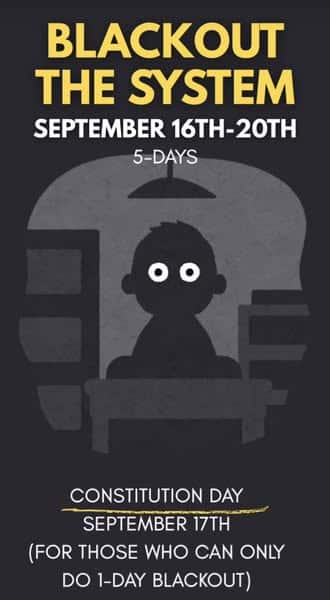
I was in San Diego with Lucy Jane, my dog, for Content Marketing World during Blackout the System in September. Even though we were traveling, I did my best to limit spending. While in San Diego, most of my meals were provided by the conference, and for the others, I brought overnight oats, instant lentils and other snacks from home. Of course, I brought all of Lucy Jane’s food from home as well. Apart from gas, I did not spend any money for the duration of the protest, including after we returned to Phoenix.
Although I regularly checked my email, I did not do any client work between September 16-20.
ChatGPT helped me write the auto-reply that went out in response to emails sent to me from outside the firm, as well as from co-workers:
I am participating in Blackout the System, September 16–20, 2025.
This national protest is built on a simple truth: ordinary people hold extraordinary power. Joe Average citizens — people like you and me — are refusing to fuel the racist, fascist, and oppressive systems that profit from our silence. For five days, we will step back. No work. No spending. No business as usual, especially not with those who support the current administration.
As a lawyer who works primarily as an independent contractor, I have a responsibility to live the values I stand for. That means showing up, even when it costs me, because that’s what real change demands.
If your needs cannot wait until at least September 21st, please contact my colleague [NAME (PRONOUNS)] at [EMAIL].
Otherwise, I invite you to sit with this question: What would happen if more of us stopped funding our own oppression?
Nothing urgent happened with any of my clients during those five days. However, when I returned to work, one of the partners stopped by my office to let me know that another attorney (but not a partner) at the firm voiced concerns that my auto-reply might reflect badly on the firm. The partner said they had no problem with what I did, but they wanted me to know that this other attorney might want to talk with me.
I never intended to offend anyone or harm the firm’s reputation (which I don’t think I did), but I made a mental note for the future to make it clear that I’m speaking and acting only on behalf of myself and my convictions.
Beyond the Boycott: Shifting Spending for Local Impact
Do protests like this work? If enough people participate, yes. According to this, 68% of the United States’ GDP is driven by consumer spending. When people take their money out of the system, the results are seen quickly, across multiple industries, including food, retail, transportation and entertainment.
Don’t participants just spend more before and after the event, so the net difference is zero? Not necessarily. Protests like this require people to be more diligent about things like meal prepping. Also, by not spending, participants avoid impulse purchases. There may also be a shift in spending away from big box stores toward local businesses, which has a stronger positive net impact on the community.
Mass Blackout: November 25–December 2, 2025
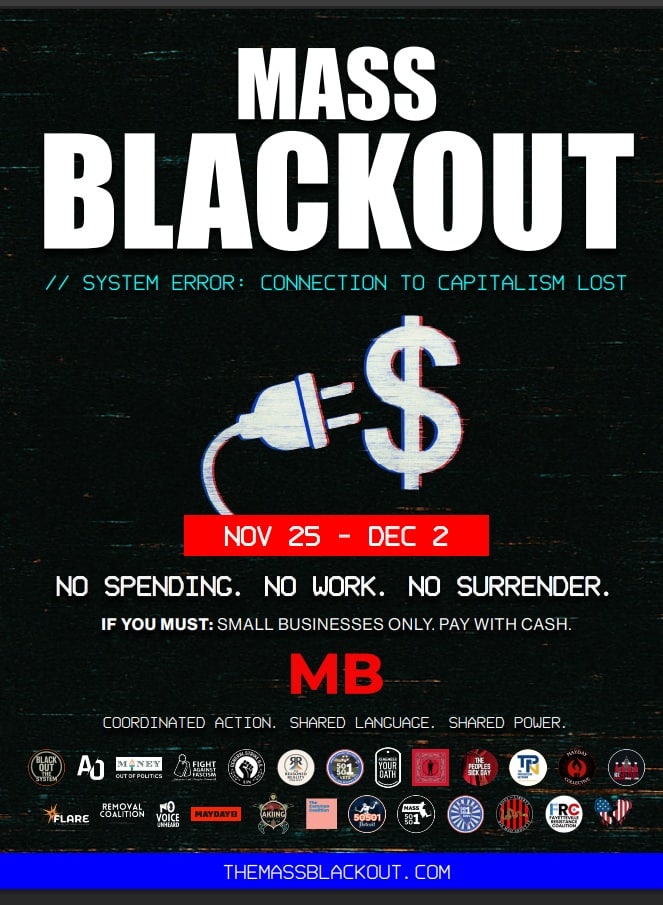
Shortly after the No Kings protest, the next Mass Blackout was announced: the Tuesday before Thanksgiving (November 25) through the Tuesday after Thanksgiving (December 2). That meant no spending except for local businesses (and with cash) for Black Friday and no spending on Cyber Monday.
I love how the organizers described this event:
“This is a coordinated economic shutdown—a collective refusal to participate in a system that profits off our pain, exploits our labor, and buys our politicians.”
Prior obligations prevented me from fully participating in this economic blackout. I had just returned from speaking at MarketingProf’s B2B Forum in Boston and had client work I needed to finish.
(Also, I can’t avoid litigation work because courts don’t care if a protest overlaps with deadlines they set.)
Once again, I asked ChatGPT to help write my auto-reply during the Mass Blackout with the goal of being more diplomatic and reducing the risk of inadvertently offending someone.
Here’s what I created with its help:
Hello, and thanks for contacting me.
I am participating in the Mass Blackout on November 25 – December 2, 2025. The Mass Blackout is a nationwide economic protest, challenging systems that profit from injustice, exploit labor, and undermine our collective power. This is a personal choice that reflects my individual values and is independent of the firm’s operations.
I will perform any work tasks I committed to prior to the start of the Mass Blackout. Additionally, per my obligations as a lawyer, I will monitor this inbox during this period; however, to honor the purpose of this boycott, I will not work on additional matters until the Mass Blackout has ended unless it is an urgent issue requiring immediate attention. If your needs cannot wait until at least December 3rd, please contact my colleague [NAME (PRONOUNS] at [EMAIL].
Moments like this remind me that individual choices, when multiplied, can shift the ground beneath us. I invite you to consider what small, intentional actions you can take to align your own values with the world you want to help build.
I thought this was pretty good, but a conversation with my litigation partner only hours before the Mass Blackout started inspired me to delete it and turn off the automatic replies.
The Quiet Strategy of the Mass Blackout
On Monday, November 24, my litigation partner and I were going over the status of our pending cases. I reminded him that I’d be participating in the Mass Blackout, but I’d still be available to help with any existing obligations, including a filing that was due December 1.
When I told him about my auto-reply, he shifted into paternal/mentor mode. He respects my beliefs, but he was concerned that telling people I’m not working because I’m participating in a protest could be a turn-off for some clients or other lawyers who want to refer me work because it could give the impression that I’m not reliable.
He also said it would have been good for me, career-wise, to go with him and another co-worker on a recent trip to Texas to see clients and colleagues. (Texas is on my list of states I won’t visit because of recently passed transphobic laws, including one that says non-binary people don’t exist, and one that says trans people can’t use the bathroom in public schools or government buildings.)
My partner is coming from a place of genuine concern. In our industry, we don’t know year-to-year, or even month-to-month, where client work will come from. He doesn’t want to see me inadvertently alienate someone who wants to either be a client or refer potential clients to me.
When Silence Speaks Loudest
Even though I’m a strong believer that if someone is offended by my values and beliefs, I’m probably not the right lawyer for them, I don’t want to create a barrier based on a misunderstanding. So, before I left the office that night, I deleted the auto-reply from my email.
I still participated in the Mass Blackout as I intended. The only difference was that I wasn’t shouting from the rooftops why I would not be available for a meeting or a call until December 3 or later. In regard to the protest, my contribution (or lack thereof, since I’m limiting work and spending) is still the same.
Image © iStockPhoto.com.

Sign up for Attorney at Work’s daily practice tips newsletter here and subscribe to our podcast, Attorney at Work Today.