

In this edition of Ask the Experts at 2Civility.org, Mark C. Palmer discusses how AI audio overview tools for lawyers can empower your practice by transforming dense legal documents into listenable content, making case review more efficient.
Table of contents
QUESTION: How can lawyers ethically adopt AI-powered audio document summarization while safeguarding client confidentiality, ensuring accuracy, and otherwise complying with professional responsibility rules?
ANSWER: Artificial intelligence is steadily expanding the ways lawyers can create, review and digest information. Among the most recent innovations are AI platforms that convert written material into highly customized audio. For busy attorneys, AI audio overview tools can make case opinions, pleadings or appellate briefs easier to absorb during a commute, a workout, or other parts of the day better suited to listening rather than reading.
These tools let users upload PDFs or other documents and instruct AI to generate precise audio summaries rooted in that source material. The result is an efficient way to stay informed while maintaining accuracy and context grounded in the original text.
Platforms such as Google’s NotebookLM, Wondercraft and Monica Podcast are at the forefront of this shift. Though not built solely for legal practice, they offer practical ways to turn dense legal documents into listenable content that complements, but never replaces, a lawyer’s professional judgment and analytical review.
In this post, I explore what some of these tools offer and the ethical responsibilities lawyers should weigh before using them.
NotebookLM
Google’s NotebookLM is an AI research and task assistant used by students and professionals across industries, including legal. With NotebookLM, lawyers can request to hear a content overview by an AI-generated “expert,” listen to an AI-generated debate about differences in sources or hear a critique of an argument.
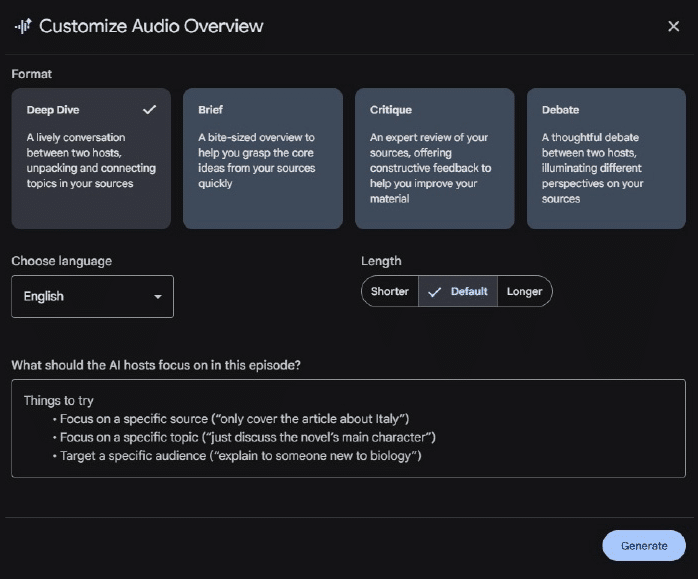
Recently, NotebookLM introduced new podcast-style features: Deep Dive, Brief, Critique and Debate. These allow lawyers to toggle between concise updates and more robust explorations of arguments, offering a flexible way to analyze evidence, highlight strengths and weaknesses, or predict counterarguments.
In addition, users can direct the AI “hosts” to focus on a particular area by typing instructions into a text field. Users may also adjust the desired length of the audio output (i.e., make the produced podcast longer or shorter) and ask the “hosts” to speak in a variety of languages.
Wondercraft
Another tool, Wondercraft, specializes in transforming written content from opinions, articles or other content into natural-sounding podcasts. Users can customize voice styles and lengths to suit different audiences, which could help law firms scale internal knowledge-sharing and client education efforts.
For lawyers, Wondercraft provides a relatively seamless way to convert documents into digestible on-demand audio. Document summaries or discussion-style presentations could be useful for both internal teams and external communications or marketing.
Monica Podcast
Likewise, Monica Podcast generates short podcast-like episodes from uploaded documents. It emphasizes simplicity and attempts to segment the uploaded content into topic areas when applicable, allowing users to quickly jump to relevant insights within the audio file.

How AI Audio Overview Tools for Lawyers Supplement Existing Processes
As noted previously, audio overviews should supplement, but not replace, a lawyer’s professional analysis of content. However, when used to enhance traditional trial preparation, drafting or critiques, this approach may offer a few benefits that text-based review cannot.
Instead of simply reading lengthy case files or research notes, audio options allow attorneys to listen to the material “come alive” in an efficient, dynamic and conversational format.
Additionally, audio may boost information retention and comprehension, especially when dealing with complex content. Research has shown that learners exposed to audio information show marked improvement in both immediate comprehension and long-term memory compared to those relying solely on reading.
For busy legal professionals, audio learning means that content can be reviewed while on the go, extending productive study time without added strain or fatigue.
Try them out! Make a few AI podcasts that review those new appellate court opinions affecting your practice and listen to them on a walk.
As Always, Ethics First
As with all uses of AI, these audio tools raise important ethical concerns, especially regarding confidentiality and supervision.
Lawyers must ensure that confidential client data is anonymized prior to uploading it into any public AI tool, with all names and identifying details redacted. Lawyers must also frequently review the platform’s privacy terms and security protocols (currently, SOC 2 Type II certification).
Ideally, the tool has a zero data retention (ZDR) policy, meaning the provider does not store user prompts, responses or other data after the AI has finished processing a task. Instead, the data is immediately deleted from memory outside the user’s account, preventing it from being used for future training or human review, helping to ensure privacy and security.
Firm policies and client agreements may dictate additional safeguards, including prohibitions of AI use altogether. And, for legal organizations and lawyers, all organizational policies on the use of AI must be coupled with training and supervision.
It is also vital to remember that these tools are only as good as the documents provided (i.e., the documents users upload). Any AI summary or critique should be carefully cross-checked for accuracy, as lawyers are responsible for the content they rely on. You do not want to be featured in the next article chastising an attorney for citing a hallucinated case.
By transforming dense legal content into dynamic audio, AI tools like NotebookLM, Wondercraft, and Monica Podcast may empower attorneys to collaborate, strategize and improve client services.
Lawyers who embrace these new tools, while maintaining their ethical commitments to confidentiality and accuracy, will find themselves better equipped to meet the fast-paced demands of modern law practice.
About the Illinois Supreme Court Commission on Professionalism
The Illinois Supreme Court established the Commission on Professionalism under Supreme Court Rule 799 to promote integrity, professionalism, and civility among the lawyers and judges of Illinois, to foster a commitment to the elimination of bias and divisiveness within the legal and judicial systems, and to ensure those systems provide equitable, effective, and efficient resolution of problems for the people of Illinois. The Commission achieves this mission through professional responsibility CLE, lawyer-to-lawyer mentoring, legal professionalism programming, educational resources, and more. To learn more, visit 2Civility.org and follow us on social media.
Illustration ©iStockPhoto.com
More Articles From Mark C. Palmer and 2Civility.org
- Generative AI for Lawyers: From Fear to Functionality, How Lawyers Can Ethically Integrate AI into Their Practice
- Be Reasonable, People! AI’s Impact on Legal Fees
- How Lawyers Can Use Code Words to Combat Client Voice Cloning and Deepfakes
- Ethical Options for Responding to Negative Online Attorney Reviews
- Harnessing ChatGPT: A Primer for Lawyers
- Should Lawyers Be Using Email Encryption?
- Ethical Pitfalls When Using ChatGPT
- Can Lawyers Ethically Store and Transmit Client Info in the Cloud?
- Ethical Considerations for Flat Fee Billing
- Leaving Your Firm? Aim for a Joint Notice to Clients
- Ethics Reminders for Lawyers Texting Clients
- Ethical Considerations of Legal Chatbots