


To beat burnout, says Karen Skinner, we need a new approach to law firm productivity.

Table of contents
If you ask most lawyers what productivity looks like, the answer is predictable.
More hours. Faster turnaround. More matters handled. Better utilization across the team.
For many, productivity has become synonymous with output. The more you produce, the more productive you are, and the better that is for everyone. At least, that’s the assumption.
But what if that assumption is wrong?
What If Better Law Firm Productivity Meant Doing Less, Not More?
In a profession where your time is literally your inventory, it’s easy to believe that every minute not spent working is a minute lost. That belief drives long days, packed schedules, and very little space to think, recover or reset.
Over time, it also leads to something else: cognitive overload.
The work lawyers do is mentally demanding. You are constantly reading, analyzing, problem-solving, anticipating risk and making decisions. If you run a practice, you are also managing people, systems and clients. That level of sustained mental effort comes at a cost.
Research in cognitive science has shown that when we engage in continuous, effortful thinking without adequate recovery, our performance declines. This is often referred to as cognitive fatigue or ego depletion. Decision-making becomes slower and less accurate. Focus drops. Mistakes increase.
In other words, the longer you work, the less effective you become.
Most lawyers don’t recognize this in real time. After all, many of us grew up in law firms where the pressure to bill was constant. I remember 36-hour stints at work, eating and sleeping at the office, and wondering why I even bothered with an apartment of my own.
We were expected to work nights and weekends. We were expected to accept every task that a partner handed us. And we took pride in our ability to suck it up and get the work done, no matter the cost. So, it’s normal for us to respond to demands by pushing harder, working longer, and doubling down on effort.
That approach might work in the short term. It does not work over the long term. We have only to look at the statistics on burnout, addiction and suicide in our profession to see the impact.
The real issue is not a lack of discipline or commitment. We’ve got that in spades. It is a misunderstanding of how productivity actually works.
A New Approach to Law Firm Productivity
High performance is not about constant output. It is about managing your energy and your attention so that you can think clearly when it matters most.
And that requires recovery.
When people hear the word “recovery,” they often think of doing nothing. Stepping away. Taking time off. While those things are important, they are not the whole picture. There is another form of recovery that is both accessible and highly effective for professionals: creative activity.
Being “creative” doesn’t mean you need to become an artist. Creativity can take many forms. Writing in a journal, cooking, gardening, playing music or even doodling on a legal pad all qualify. What matters is that you are engaging your brain in a different way.
Shifting Into Creative Activity
When you shift into a creative activity, you give your analytical mind a break. At the same time, you activate different parts of the brain that support problem-solving, pattern recognition and insight.
This is not theoretical. In fact, you’ve likely already experienced it yourself.
Think about a time you stepped away from a problem, did something unrelated, and came back with a clearer perspective. The solution that felt out of reach suddenly became obvious.
That is not a coincidence — it’s how your brain works when it is given space.
The challenge is that most lawyers do not give themselves that space. The pressure to stay busy, to stay responsive and to stay “productive” overrides the instinct to step back. As a result, many of us operate in a constant state of mental fatigue, without realizing that our current approach is actually limiting our effectiveness.
If you want to improve your productivity, the answer is not always to do more.
Sometimes, the most productive thing you can do is step away from the work.
Not to avoid it, but to come back to it better.
That shift may feel counterintuitive. It may even feel uncomfortable at first. But it is often the difference between spinning your wheels and moving forward with clarity.
More Law Firm Productivity and Process Improvement Tips
- Delegation Isn’t Just a Work Hack, It’s a Life Hack: 5 Personal Tasks to Delegate Now
- 5 Tips to Make Time Entry Less Painful for Lawyers
- Law Firm Intake: 3 Tips to Save Time and Convert More Clients
- New Client Onboarding: 5 Tips to Win Over New Clients
- Time to Build Your Team: 5 Steps to Improve Your Hiring Process
- From Hire to Higher: 6 Ways to Improve Employee Onboarding
- Delegating Legal Work: 7 Tips to Scale Your Practice
- Want to Get Paid Faster? 5 Ways to Fix Law Firm Invoicing
- How to Create a Law Firm Annual Plan that Doesn’t Die in a Drawer
- Three Keys to a Healthy Referral Network
- The 3 Best Reasons to Use Visual Matter Management to Run Your Law Practice
- Got a Process for Your Processes? Create Law Firm SOPs in 5 Easy Steps
- The 5-Minute Matter Review: A Weekly Ritual for Project-Oriented Law Firms
- Three Legal Project Management Tips for More Profitable Flat Fees
- Stop Wasting Time: How to Run More Efficient Law Firm Meetings
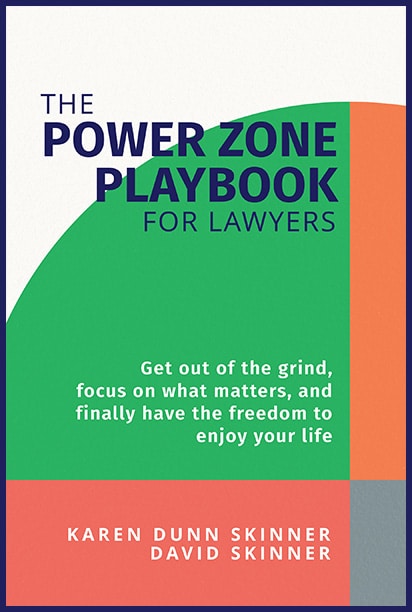
Get the Power Zone Playbook for Lawyers
By Karen Dunn Skinner and David Skinner
Get out of the grind and into your power zone! Learn to align the work you do with the work you love, finding the sweet spot where your expertise, passion, and client needs intersect. It’s here, in your Power Zone, that you will discover the secret to a thriving practice.
Everything you need is in your Playbook.
Images © iStockPhoto.com