


Is your day filled with internal team syncs, virtual client consultations, and trips to the courthouse? In today’s fast-paced hybrid legal market, managing it all at a glance requires smart automation, making a deep understanding of outlook categories essential for the modern professional. Try these tricks, adapted from Affinity Consulting Group’s “Microsoft Outlook for Legal Professionals.”

Table of contents
Introduction to How to Use Categories in Outlook
Categories allow you to “color-code” emails, tasks, appointments, and contacts. Categories carry across Outlook. If you create a new color category while updating an appointment, that same color category will be available for email, tasks, and contacts. The default category feature through the Quick Click function allows you to easily assign a frequently used category to your messages, enhancing productivity and organization in your inbox. Categories can be used to color-code things, and they can be used to filter.
Each category is assigned a color. While you can assign multiple categories the same color, most people assign each category a unique color to help distinguish them at a glance. Color-coding is especially useful on your calendar.
Setting Up Categories
Categories are on the Home ribbon when you are in email. From your calendar, they are in the Event menu. You can also find them by right-clicking on an email, appointment, task or contact.
Whichever way you open the categories dialog box, from Categorize, select All Categories… at the bottom of the list.
Use the categorize menu to set a Quick Click category for messages and manage your categories more efficiently.
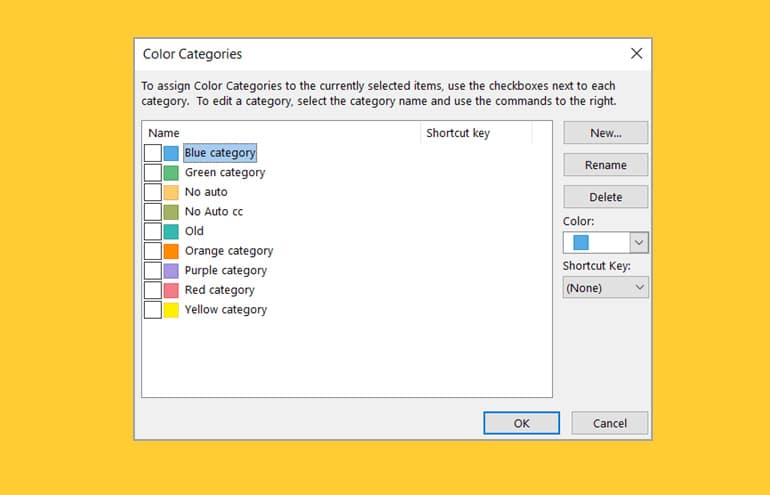
The Color Categories dialog box allows you to create and rename categories, select colors, and assign shortcut keys, which is essential for organizing messages and calendar events.
Outlook contains categories like red, blue and yellow out of the box. Either rename those to something meaningful to you or delete them and start from scratch. When setting up categories, think about ways you’d like to color-code your calendar (or emails, tasks and contacts). What do you want to be able to tell at a glance? Do you want to know whether your meetings are internal ones, ones with the client, or ones with the court? Set up a category for each of those.
For example, if internal meetings are yellow, client meetings are red, and hearings are blue, just by glancing at your Outlook calendar, you’ll know what types of meetings are in store for you.
Applying Color Categories
Right-click on the email, appointment, task or contact to apply a category. Under Categorize, select the category to apply. To apply additional categories, right-click and select a new category. To manage color categories, right-click and select Categorize. Categories can also be applied to email from the Home ribbon and meetings from the Events tab.
If the available list of categories is insufficient, you can select Manage categories to access more options and assign the appropriate categories for your emails.
You can also assign shortcut keys to up to 11 categories to simplify applying categories. From the Categories dialog, select a category. On the right-hand side, select a shortcut key from the dropdown menu. Ctrl + F2 – F12 are available as shortcut options.
In the Tags group on the Ribbon, you can categorize and organize messages, calendar items, and tasks for better tracking and sorting.
You can also add the Categorize dropdown to your Quick Access Toolbar. Right-click on the Categorize button from the email Home ribbon and select Add to Quick Access Toolbar. Your foundational outlook categories will now always be a single click away.
Filtering and Managing Categories
Once you start using categories, you can use them to filter your email, calendar, tasks, and contacts. To manage categories, from the View ribbon, click on View Settings. Then click on the Filter… button. On the More Choices tab, click on the Categories… button to select the categories you want to filter for.
To save the filtered view, on the View ribbon, click on Change View and select Save Current View as a New View. Then, you can filter for the same categories by switching to that view going forward. Filtered views are especially helpful for looking into court dates or deadlines in the future, decluttering the view of your most important dates. Organizing your Outlook inbox using color-coded categories can significantly enhance your email management, making it easier to find and categorize messages efficiently.
Frequently Asked Questions About Outlook Categories
No. The categories and colors you assign to items in your mailbox or calendar are strictly private and unique to your view. If you categorize a calendar invite or an email received from someone else, your changes apply only to your own calendar layout and will not affect the sender’s or other attendees’ Outlook views.
If the Categorize option is grayed out or unavailable, it is most likely because you are using an IMAP email account setup. Outlook color categories are fully supported on Microsoft Exchange accounts (such as M365). If you are using IMAP, categories are generally restricted for email items but may still be used on localized calendar events and tasks.
To rename a category in the modern Outlook interface, go to Settings > Accounts > Categories. In the Categories pane, click the Edit (pencil) icon next to the category you want to modify, type your new preferred name, and click Save. Any existing items already tagged with that category will automatically update to reflect the new name.
Yes. Outlook allows you to apply multiple color categories to a single item. This is incredibly useful for legal professionals who want to track an event by both the type of meeting (e.g., Client Consultation) and the specific case/matter name (e.g., Smith Case).
Learn More Outlook Tricks
Learn more tricks like this in Affinity Consulting Group’s “Microsoft Outlook for Legal Professionals.”
Affinity Consulting Group inspires, enables, and empowers legal teams of all sizes to work smarter, from anywhere. The company’s holistic approach incorporates people, process, and technology. Affinity’s passionate, well-connected industry experts work hand in hand with you to help you better understand and optimize your business — from software to growth strategy, and everything in between.
Illustration ©iStockPhoto.com
Subscribe to Attorney at Work
Get really good ideas every day for your law practice: Subscribe to the Daily Dispatch (it’s free). Follow us on Twitter @attnyatwork.