


You are a professional. Not a commodity. Flat-fee pricing lets you lean into that identity, but only if you price for the real risk you’re carrying.

Table of contents
- The Baseline Math: What Would You Charge If You Billed by the Hour?
- Why Add 20% to Your Fees? The Distribution Curve
- Real-World Example: When Risk Isn’t Priced Into Flat Fees
- Pushback on Flat-Fee Pricing for Legal Services
- Track These Metrics or Fly Blind
- Start Small: Build One Flat-Fee Offering
- More Profitable Law Firm Tips from Brooke Lively
The Baseline Math: What Would You Charge If You Billed by the Hour?
Hourly billing is riskless — for the lawyer. But shift to flat fees and do it right, and you’re the one taking the risk. The person who takes the risk should get the reward. That’s not greed, it’s just business math.
Let’s start here: If you want to charge a profitable flat fee, you have to know what the work would cost hourly. Sounds obvious, but recently I worked with a lawyer who had to wrestle with this idea in real time.
He runs a trust and estate firm. When we got into the weeds on pricing his flat-fee services, he was struggling. Not with the flat fee itself, but with figuring out what he would even charge if he billed by the hour. After some digging, we broke it down this way:
- What do you pay your average associate attorney? This should be grossed up to include taxes and benefits.
- What type of return do you expect to get on the attorney? If they are young, the answer is 5, if they spend most of their time teaching, training, managing clients, and out getting new clients, the answer will be closer to 3X.
- How many hours a day or week do you expect them to do billable work? The answer is not 8. Most people can only bill about 75% of the time they work. For solo attorneys, that percentage is much lower.
At this point, he wasn’t really sure where I was going, but then I showed him how to use the inputs:
- Multiply the salary + taxes by the multiple to get Yearly Billing
- Multiply the hours billed per week by 46 weeks in a year (2 weeks of vacation, 2 weeks of federal holidays, and 2 weeks of “shit happens”) to get Yearly Hours
- Divide the Yearly Billing by Yearly Hours to get the Hourly Rate
Suddenly, the numbers started lining up, and that’s when the light bulb turned on. He looked at me and said, “No wonder I’m not making what I thought I would. I’ve been guessing.”
But the real “aha” came next, when we talked about risk.
Why Add 20% to Your Fees? The Distribution Curve
Think about your last 20 cases. Some were fast and easy. Some dragged on forever. And some, the ones that eat your lunch, blew the timeline, scope and your team’s sanity all at once.
That’s the distribution curve at work:
- Left tail: Quick wins that take half the time you expected.
- Middle: The average matter, pretty close to the estimate.
- Right tail: Time-sucking monsters that kill your margins.
If you base your price on how long a matter takes on average, you are doing it based on the dead center of that curve. When you charge a flat fee, you’re absorbing that risk. And if you’re taking the risk, you deserve to get paid for it.
That’s why I recommend bumping your baseline price by 20%. It’s not random, it’s a smart hedge.
Real-World Example: When Risk Isn’t Priced Into Flat Fees
Back to the estate planning lawyer. Once we priced out his flat fees based on hourly cost plus 20%, things clicked. He realized that in almost every service, he had been underpricing his risk. He was charging for average cases but delivering results on worst-case scenarios.
No wonder the firm’s profits didn’t match the effort.
Once we implemented the 20% rule, his margins jumped. Not because he gouged anyone, but because he stopped donating his time to high-maintenance clients.
Pushback on Flat-Fee Pricing for Legal Services
Here are the most common arguments I hear about switching to flat fees, and why they’re wrong.
- “What if I overcharge?”
Then add more value. Or offer a satisfaction guarantee. Most lawyers undercharge. A little cushion won’t hurt your reputation. - “Clients won’t go for flat fees.”
False. Clients hate uncertainty. Predictable pricing wins trust. Just look at how SaaS companies sell everything now. Simplicity sells. - “I don’t know how long it will take.”
Then start tracking. Build data. Get better. You’ll never improve if you keep pricing from the gut. - “What if I lose money on a case?”
You will. Sometimes. That’s the game. But with the 20% cushion, your average case stays profitable. And that’s what matters.
Track These Metrics or Fly Blind
To make flat-fee pricing for legal services sustainable, monitor these metrics monthly:
- Effective hourly rate (flat fee ÷ actual time spent)
- Profit margin per matter (% over your hourly baseline)
- Variance range (high vs. low time/cost outliers)
- Number of “lunch-eating” cases (track and analyze them, don’t just complain)
Flat fees only become dangerous when you stop measuring.
Start Small: Build One Flat-Fee Offering
Here’s how to test flat fee pricing for your legal services in the real world:
- Pick one common, repeatable matter — an estate plan, LLC formation or basic contract review, for example.
- Estimate the time required to complete the matter. Multiply by your hourly rate.
- Add 20%.
- Offer it as a flat fee.
- Track your actual time on each new matter.
- Refine from there.
The more you do it, the more precise and profitable you’ll get.
Bottom line: You are a professional. Not a commodity. Flat fee pricing lets you lean into that identity, but only if you price for the real risk you’re carrying. Stop pricing like everything will go smoothly. It won’t.
And when it doesn’t, that 20% is what keeps your practice profitable.
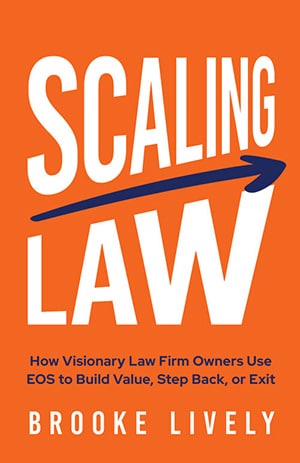
Want to Scale Faster and Build a Stronger Firm?
Scaling Law helps entrepreneurial lawyers apply real business strategy to legal practice. Get Brooke Lively’s new book and join the Scaling Law community. You’ll find lawyers who’ve implemented the Entrepreneurial Operating System (EOS), trading guesswork for structure — and chaos for real traction.
More Profitable Law Firm Tips from Brooke Lively
For more tips on building a more profitable law firm, read:
- Are Your Law Firm’s Financial Systems Ready to Scale?
- The Path to Partnership: Embracing the ‘P’ Word Is the Key to Law Firm Growth
- Law Firm Profits and Year-End Taxes: Avoiding a Surprise Tax Bill
- 5 Ways You May Be Sabotaging Your Firm’s Growth
- The Best Compensation Plans Use the Law of Thirds
- Law Firm Overhead: What It Is — and What It Isn’t
- Building a Law Firm That Pays You First
- Understanding Law Firm Profits — And What to Do With Them
- How Are Law Firm Owners Paid? Total Compensation vs. Salary
- Funding Growth: Are You Starving Your Law Firm?
Image © iStockPhoto.com.

Sign up for Attorney at Work’s daily practice tips newsletter here and subscribe to our podcast, Attorney at Work Today.